Showing posts with label Astronomy. Show all posts

Thursday, 31 January 2019

Can moons have moons?

A new study shows that Earth’s moon should, theoretically, be able to have its own moon. Why doesn’t it?

Size comparison of the major moons in our solar system 

Most of the planets in our solar system have orbiting moons, and even some asteroids have their own moons. But do any moons have moons? Is it possible? Could there be so-called submoons?

It’s a simple enough question. If most other objects in the solar system can have moons, why not moons themselves? Researchers decided to try to answer this question of a 4 year old. Their results have now been published in a new peer-reviewed paper in the February 2019 issue of the Monthly Notices of the Royal Astronomical Society.

Planets orbit stars and moons orbit planets, so it is natural to ask if smaller moons could orbit larger ones. So far at least, no submoons have been found orbiting any of the moons considered most likely to support them – Jupiter’s moon Callisto, Saturn’s moons Titan and Iapetus and Earth’s own moon.

The lack of known submoons in our solar system, even orbiting around moons that could theoretically support such objects, can offer us clues about how our own and neighboring planets formed, about which there are still many outstanding questions.
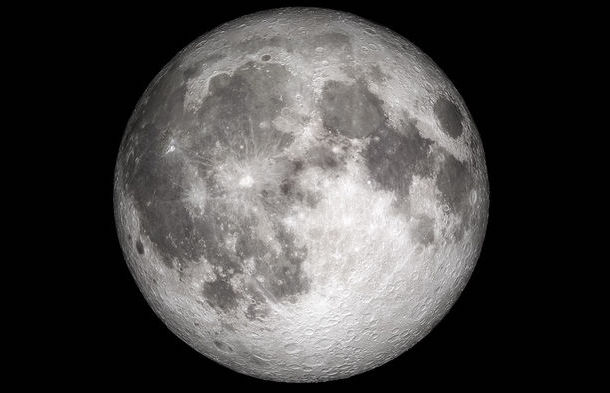
Earth’s moon should theoretically be able to have its own moon. Why doesn’t it?

Researchers found that only large moons on wide orbits from their host planets would be capable of hosting submoons. Usually, any submoons orbiting smaller moons closer to their planet would have their orbits destabilized by tidal forces. Jupiter’s large moon Callisto, Saturn’s large moon Titan, another Saturn moon called Iapetus and Earth’s moon could all theoretically have submoons, so why don’t they?

There may be other sources of submoon instability, such as the non-uniform concentration of mass in Earth’s moon’s crust.

Part of the answer might also have to do with how the primary moons formed in the first place. Earth’s moon is thought to have been born out of a collision between Earth and another body about the size of Mars – and that collision may have helped life on Earth to get started. But some other moons, like those orbiting Jupiter and Saturn, originated from the same cloud of gas and dust that the planets themselves formed from.
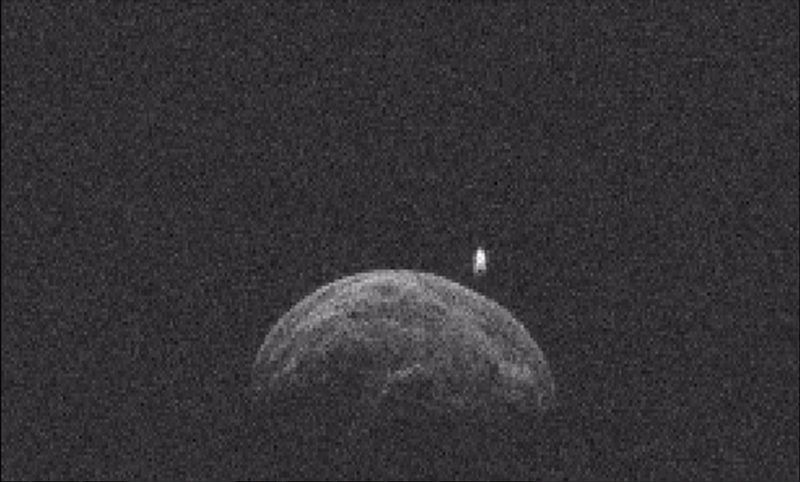
Even asteroids can have moons, such as 2004 BL86. It is about 325 meters in diameter, and its moon is tiny, only 70 meters wide.

It may be that in many or even most cases, there are multiple factors that make the orbits of submoons inherently unstable. Knowing whether that is true or not may have to wait for discoveries of moons orbiting distant exoplanets. Moons themselves are much harder to detect and only one promising candidate has been found so far – a possible exomoon orbiting the Jupiter-sized exoplanet Kepler-1625b. That possible moon – about the size of Neptune – is large enough and far enough from its planet that submoons should be possible as well. Astronomers will need to verify that primary moon first – if it does exist – before looking for any submoons.

Even though Earth’s moon doesn’t have a submoon now, it may in the future, according to the researchers – an artificial one, perhaps NASA’s planned Lunar Gateway. The Lunar Gateway would help to establish humanity’s presence in deep space.

The possibility of moons having their own moons is a fascinating one, even though we haven’t found any examples yet. This new research from Carnegie Science shows that it is indeed possible, but only under the right circumstances.

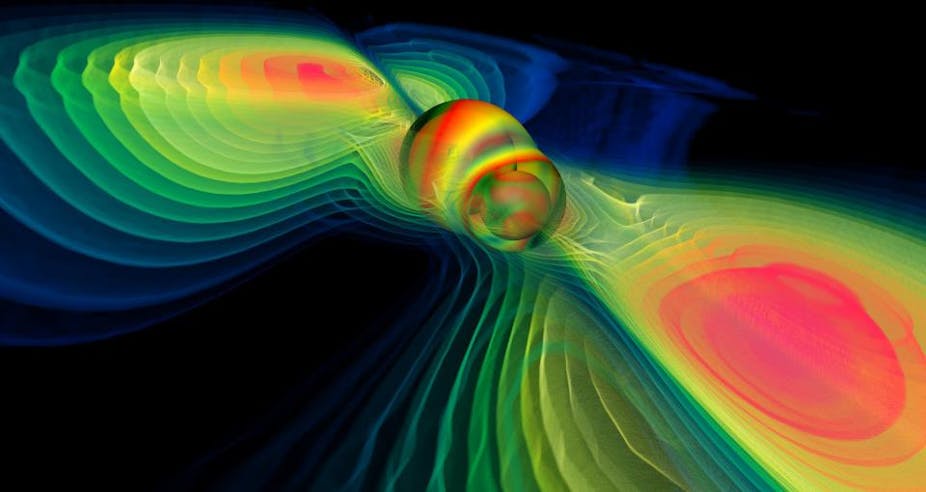
Download the research paper here.

Adapted from EarthSky.org

Wednesday, 24 January 2018

How massive can neutron stars be?

In 2016, when the twin LIGO detectors made their first historic observation of gravitational waves, astronomers heralded the news both as a confirmation of Einstein’s general relativity and also because, as they love to say, the detection opened a new window on the cosmos.

On January 16, 2018, astrophysicists at Goethe University in Frankfurt, Germany described how they used observations of gravitational waves to answer a question that’s plagued scientists since the 1960s, when they first discovered neutron stars, or stars composed predominantly of closely packed neutrons. By definition, a neutron star has a very small radius and very high density (a teaspoon of neutron star material would weigh about 10 million tons). A typical neutron star mass is about 1.4 suns.

Notice all the abouts in those last couple of sentences? Now, for the first time, astrophysicists have succeeded in putting more precision into those numbers, by calculating a strict upper limit for the maximum mass of neutron stars. They say that, with an accuracy of a few percent, the maximum mass of non-rotating neutron stars cannot exceed 2.16 solar masses.

What happens to a neutron star that does exceed its mass limit? In that case, the neutron star collapses into an even more compressed and vastly more exotic object known as a black hole.

Source - EarthSky.org

Monday, 30 October 2017

What are gravitational waves?

Computer simulation of two merging black holes producing gravitational waves.
Scientists working at the LIGO experiment in the US detected elusive ripples in the fabric of space and time known as gravitational waves. There is no doubt that the finding is one of the most groundbreaking physics discoveries of the past 100 years. But what are they?

To best understand the phenomenon, let’s go back in time a few hundred years. In 1687 when Isaac Newton published his Philosophiæ Naturalis Principia Mathematica, he thought of the gravitational force as an attractive force between two masses – be it the Earth and the Moon or two peas on a table top. However the nature of how this force was transmitted was less well understood at the time. Indeed the law of gravitation itself was not tested until British scientist Henry Cavendish did so in 1798, while measuring the density of the Earth.

Fast forward to 1916, when Einstein presented physicists with a new way of thinking about space, time and gravity. Building on work published in 1905, the theory of general relativity tied together that what we commonly consider to be separate entities – space and time – into what is now called “space-time”.

Space-time can be considered to be the fabric of the universe. That means everything that moves, moves through it. In this model, anything with mass distorts the space-time fabric. The larger the mass, the larger the distortion. And since every moving object moves through space-time, it will also follow the distortions caused by objects with big mass.

One way of thinking about this is to consider two children, one heavier than the other, playing on a trampoline. If we treat the surface of the trampoline as the fabric then the more massive child distorts the fabric more than the other. If one child places a ball near the feet of the other then the ball will roll towards, or follow the distortion, towards their feet. Similarly, when the Earth goes around the sun, the huge mass of the sun distorts the space around it, leaving our comparatively tiny planet following as “straight” a path as it can, but in a curved space. This is why it ends up orbiting the sun.

Trampolines: fun and educational
If we accept this simple analogy, then we have the basics of gravity. Moving on to gravitational waves is a small, but very important, step. Let one of the children on the trampoline pull a heavy object across the surface. This creates a ripple on the surface that can be observed. Another way to visualise it is to consider moving your hand through water. The ripples or waves spread out from their origin but quickly decay.

Any object moving through the space-time fabric causes waves or ripples in that fabric. Unfortunately, these ripples also disappear fairly quickly and only the most violent events produce distortions big enough to be detected on Earth. To put this into perspective, two colliding black holes each with a mass of ten times that of our sun would result in a wave causing a distortion of 1% of the diameter of an atom when it reaches the Earth. On this scale, the distortion is of the order of a 0.0000000000001m change in the diameter of the Earth compared to the 1m change due to a tidal bulge.

What can gravitational waves be used for?

Given that these ripples are so small and so difficult to detect, why have we made such an effort to find them – and why should we care about spotting them? Two immediate reasons come to mind (I’ll leave aside my own interest in simply wanting to know). One is that they were predicted by Einstein 100 years ago. Confirming the existence of gravitational waves therefore provides further strong observational support for his general theory of relativity.

In addition, the confirmation could open up new areas of physics such as gravitational-wave astronomy. By studying gravitational waves from the processes that emitted them – in this case two merging black holes – we could see intimate details of violent events in the cosmos.

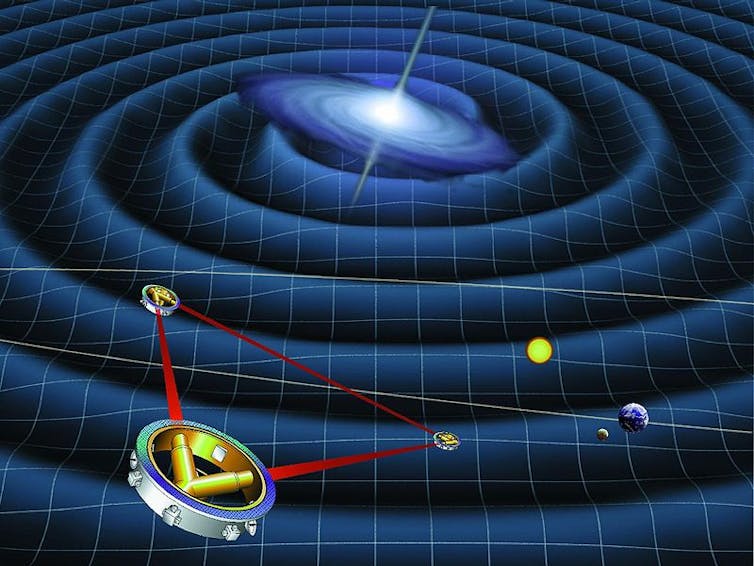
LISA, a planned space-based laser interferometer, could study astrophysical sources of gravitational waves in detail
However, to make the most of such astronomy, it is best to place the detector in space. The Earth-based LIGO managed to catch gravitational waves using laser interferometry. This technique works by splitting a laser beam in two perpendicular directions and sending each down a long vacuum tunnel. The two paths are then reflected back by mirrors to the point they started at, where a detector is placed. If the waves are disturbed by gravitational waves on their way, the recombined beams would be different from the original. However, space-based interferometers planned for the next decade will use laser arms spanning up to a million kilometres.

Now that we know that they exist, the hope is that gravitational waves could open up the door to answering some of the biggest mysteries in science, such as what the majority of the universe is made of. Only 5% of the universe is ordinary matter with 27% being dark matter and the remaining 68% being dark energy, with the latter two being called “dark” as we don’t understand what they are. Gravitational waves may now provide a tool with which to probe these mysteries in a similar way that X-rays and MRI have allowed us to probe the human body.


Wayward moon is receding from Earth


From 1969 to 1972, Apollo astronauts had left laser reflectors on the moon’s surface, enabling astronomers to measure the moon’s distance from Earth with great accuracy. Although the moon’s distance from earth varies each month because of its eccentric orbit, the moon’s mean distance from Earth is nonetheless increasing at the rate of about 3.8 centimeters (1.5 inches) per year. That’s about the rate that fingernails grow.

Tidal friction with the Earth’s oceans is responsible for this long-term increase of the moon’s distance from Earth. It’s causing the moon to spiral into a more distant orbit. Tidal friction also slows down the Earth’s rotation, lengthening the day by about 1 second every 40,000 years. Hence, the number of days in a year is slowly diminishing over the long course of time.

Simulations suggest that at the time of the moon’s formation some 4.5 billion years ago, the moon was only about 20,000 to 30,000 kilometers from Earth. Way back then, Earth’s day might have been only 5 or 6 hours long. That would mean over 1,400 days in one year!

The Apollo 11 lunar laser ranging retroreflector array on the moon.
However, astronomers suspected the moon was receding from Earth before the heyday of the Apollo astronauts. Edmund Halley’s (1656 to 1741) studies of ancient solar and lunar eclipses suggested the possibility, as well. George Howard Darwin (1845 to 1912) is credited for figuring out mathematically how tidal friction affects the moon’s orbit.

Studies in fossilized coral indicate that the Earth had spun faster upon its rotational axis when the moon was closer to Earth. Millions of years ago, days on Earth were shorter yet more abundant. For instance, around 900 million years ago, there were about 480 18-hours days in one year. Around 400 million years ago, there were about 400 22-hour days in one year. Looking into the future, astronomers expect longer days but fewer of them in one year.

If the lifetime of the Earth-moon system lasts long enough (which is doubtful), it is projected that after many billions of years, the same sides of the Earth and moon would face one another. In other words, the Earth’s rotational period and the moon’s orbital period would equal one another, representing a period of 47 days. At that time, the Earth/moon distance would expand to some 560,000 km, exceeding the present distance of 384,400 km by nearly 150%.

Source - EarthSky.org

Wednesday, 4 October 2017

After 60 years, where is Sputnik?

The tiny sphere that launched the space race 6 decades ago on 4th October.

When the Soviet Union launched the first artificial satellite 60 years ago, it marked both the beginning of space exploration and the start of a race between Moscow and Washington. Sputnik, the tiny silver sphere with four spider leg-like antennae, showed off Soviet technological prowess.


But German scientists (who had worked on Adolf Hitler's rocket projects and brought to the USSR after the war) were the ones who stood at the forefront of space achievement.

The founder of the Soviet space programme, Sergei Korolyov, worked with German scientists and fragments of the German FAU rocket to develop a new military missile. The Korolyov bureau had to create an intercontinental rocket capable of carrying a hydrogen bomb to any point on the planet.

Sergei Korolyov

As he worked for the military, Korolyov (who spent six years in the Gulag) dreamt of space conquest. But time was running out: one of the principal German engineers, Wernher von Braun, was already working for the Americans.

Wernher Von Braun, with his arm in a cast from a car accident, surrendered to the Americans just before this May 3, 1945 photo.

After three years of work and three rocket accidents, the fourth R-7 (R-7 is the rocket which put Sputnik into orbit) with a dummy warhead successfully hit its target in Kamchatka, in the Far East, in August 1957. The test was hailed as successful although the rocket head disintegrated in flight.

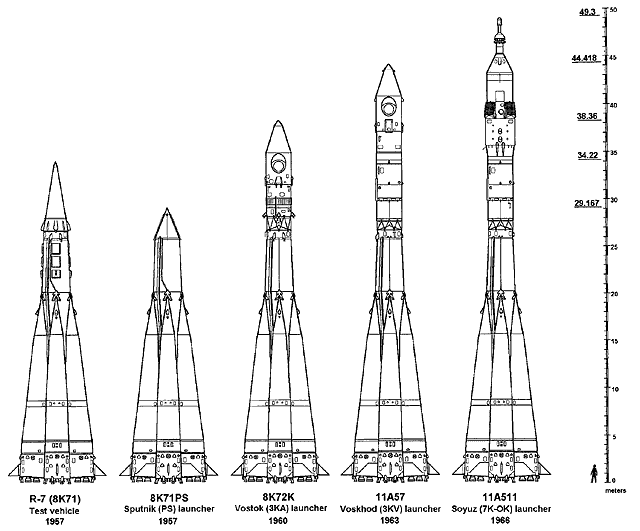
Evolution of Soviet space launch vehicles in the early years. From the left are the R-7 ICBM (Intercontinental Ballistic Missile), the Sputnik launcher, the Vostok launcher, and the Soyuz launcher - size in comparison with an average human

Creating a new rocket head would take six months, much too long as the Soviets wanted to pre-empt the launch of a US satellite in 1958. So Korolyov suggested creating a simple satellite made of two hemispheres containing sensors, a radio and a battery pack. In just two months, the apparatus measuring 58 centimetres in diameter and weighing 63.8 kilograms was ready.


Though the satellite captured imaginations, Sputnik 1 was secondary to its inventors. The most important thing was that it proved the effectiveness of the R-7 rocket. The secrecy around the project meant that most of the scientists involved didn't learn of the actual launch until they heard on the radio that the first Earth satellite was put in orbit on October 4, 1957 from a testing range in Kazakhstan, the future Baikonur cosmodrome. (1957 was observed as the International Geophysical Year).

It was a tiny dot which shone in the sun because of the glossy surface. The satellite travelled at about 29,000 kilometres per hour (8,100 m/s), taking 96.2 minutes to complete each orbit.

A replica of Sputnik 1, the first artificial satellite in the world to be put into outer space.
It transmitted on 20.005 and 40.002 MHz, which were monitored by amateur radio operators throughout the world. The signals continued for 21 days until the transmitter batteries ran out on 26 October 1957. Sputnik was in orbit for 92 days, making 1,440 circles around Earth, before losing speed and burning up in the atmosphere on 4 January 1958.

Tracking and studying Sputnik 1 from Earth provided scientists with valuable information, even though the satellite itself wasn't equipped with sensors. The density of the upper atmosphere could be deduced from its drag on the orbit, and the propagation of its radio signals gave information about the ionosphere.

Nikita Khrushchev, Premier of the Soviet Union, was pleased with the success of Sputnik 1, and encouraged launch of a more sophisticated satellite less than a month later in time for the 40th anniversary of the October Revolution on 3 November.

Model of Sputnik 2 at the Polytechnic Museum in Moscow

This new Sputnik 2 spacecraft had six times the mass of the Sputnik 1, and carried the dog Laika as a payload. The entire vehicle was designed from scratch within four weeks, with no time for testing or quality checks. It was successfully launched on 3 November and Laika was placed in orbit. There was no mechanism to bring the dog back to Earth, which died from heat exhaustion after five hours in space.

Hungarian stamp honouring Laika

The instrument-laden Sputnik 3 spacecraft was sent into orbit on 15 May 1958. The tape recorder that was to store the data failed after launch. As a result, the discovery and mapping of the Van Allen radiation belts was left to the United States' Explorer 3 and Pioneer 3 satellites.

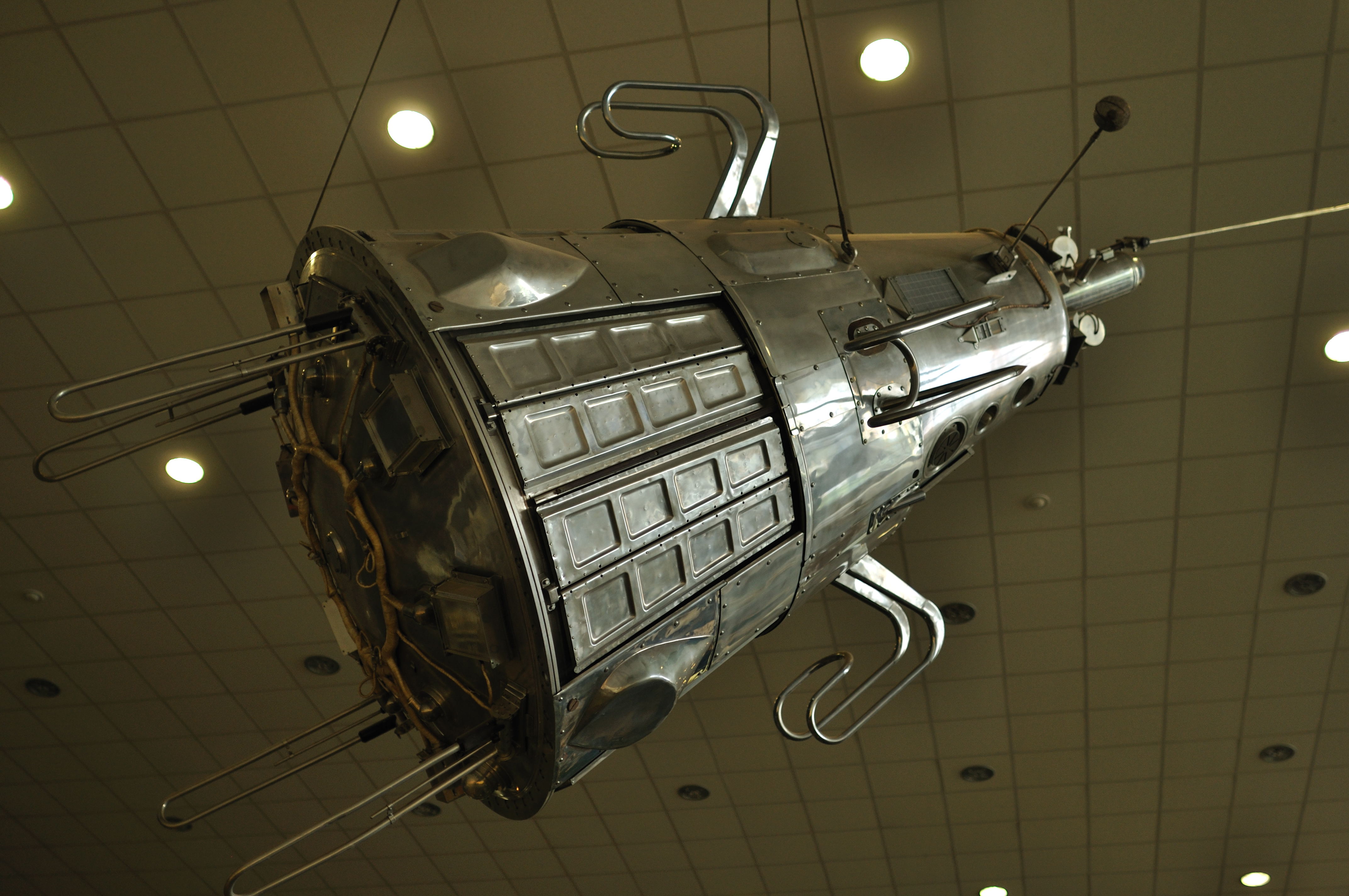
Sputnik 3 

Several replicas are now on show in museums. At least two vintage duplicates of Sputnik 1 exist, built apparently as backup units. One resides just outside Moscow in the corporate museum of Energia, the modern descendant of Korolyov's design bureau, where it is on display by appointment only. Another is in the Museum of Flight in Seattle, Washington. Unlike Energia's unit, it has no internal components, but it does have casings and molded fittings inside (as well as evidence of battery wear), which suggest it was built as more than just a model.

Sergei Khrushchev claimed that the Nobel Prize committee attempted to award Korolyov but the award was turned down by Khrushchev in order to maintain harmony within the Council of Chief Designers.


Extract from an article by Marina Lapenkova in Phys.Org and Wikipedia. Images Source - Wikipedia

Wednesday, 5 July 2017

Juno shatters scientists' Jupiter theories in just 365 days

LAST JULY 4TH, NASA's Juno spacecraft slowed its record breaking pace just enough to get caught in the pull of Jupiter's gravity. (The timing, according to NASA, was just a very patriotic coincidence.) Either way, Independence Day 2016 was the last time the Juno mission pumped its brakes. In the year since, the 66-foot solar-powered craft has given scientists more and weirder Jupiter data than they ever thought possible.

So, in honor of Juno's first year orbiting the hitherto mysterious gas giant, here's a rundown of the mission's greatest scientific hits so far.

The Design

Without a good spacecraft and mission plan, Juno never would have left orbit. The Lockheed Martin-built spacecraft itself is an engineering marvel: It has traveled further from Earth (1.7 billion miles!) than any solar-powered craft preceding it, and at speeds never before achieved by a man-made object. Juno's engineers also had to protect the craft's delicate instrumentation—which does everything from snap photos to analyze the gas giant's core—from deep space's pipe-burstingly cold temperatures, not to mention Jupiter's powerful radiation and electric field.

None of which would have been helpful if the mission design didn't allow all that fancy machinery to collect good data. Fortunately for Juno, that hasn't been an issue, even though its flight plan is unconventional in the extreme. Not only are Juno's orbits way, way lower than usual—at their lowest points, just 2,500 miles above Jupiter's famous storm clouds—unlike previous Jupiter missions, they're closely spaced to allow the craft to map the entirety of the planet. "Now that we've had such success, we can say the design is one of our greatest achievements," Scott Bolton, Juno's principal investigator told WIRED in May.

The Poles

The other eccentricity of Juno's orbit is that it isn't equatorial. Instead, it skims over Jupiter's north and south poles, which no one had ever seen before because of Jupiter's very slight axial tilt. (Most planets are tipped over enough for scientists to get a look at their poles from Earth, but Jupiter is practically straight up and down.) Turns out they're stunning—shockingly blue compared to the rest of the planet's stripy orange and white, and covered in cyclones that could swallow Earth whole.

The Atmosphere

So far, Juno has only completed one close pass of Jupiter—what Juno's team calls a science orbit. And while there are still a number of them to go (12 or more, thanks to an engine glitch that actually ended up shielding the spacecraft from additional radiation damage), the results of the first have already challenged long-held scientific theories about gas giants.

Seriously: Jupiter's auroras get energized by pulling electrons out of polar regions (the opposite of how the process works on Earth); and the gas giant's atmosphere, magnetic field, and gravity field are way more mobile and variable than scientific wisdom would have suggested. It's gotten to the point where planetary scientists (including Bolton) wonder if any of their assumptions about gas giants were right.

Which doesn't mean Juno is discouraging scientists. It's the opposite, really. Juno was always meant to rewrite (or at least fill in missing bits of) planetary history. According to theories Juno hasn't yet busted, Jupiter is the planet that started it all in this solar system—its composition is essentially the same as the Sun's, except it's enriched with heavier elements like carbon and nitrogen. So, it's the Sun plus the ingredients for life soup. And while scientists and space fans will have to wait for the next few science orbits to learn what that means, with Juno's track record, whatever answers the spacecraft sends Earthward will likely be field-shaping, and unexpected. So happy first anniversary, Jupiter and Juno. We can't wait to see what science your next year together will bring.

Follow NASA's Juno Mission on Twitter @NASAJuno

Source - www.wired.com

Friday, 15 April 2016

1. Telescope - Let's calibrate!

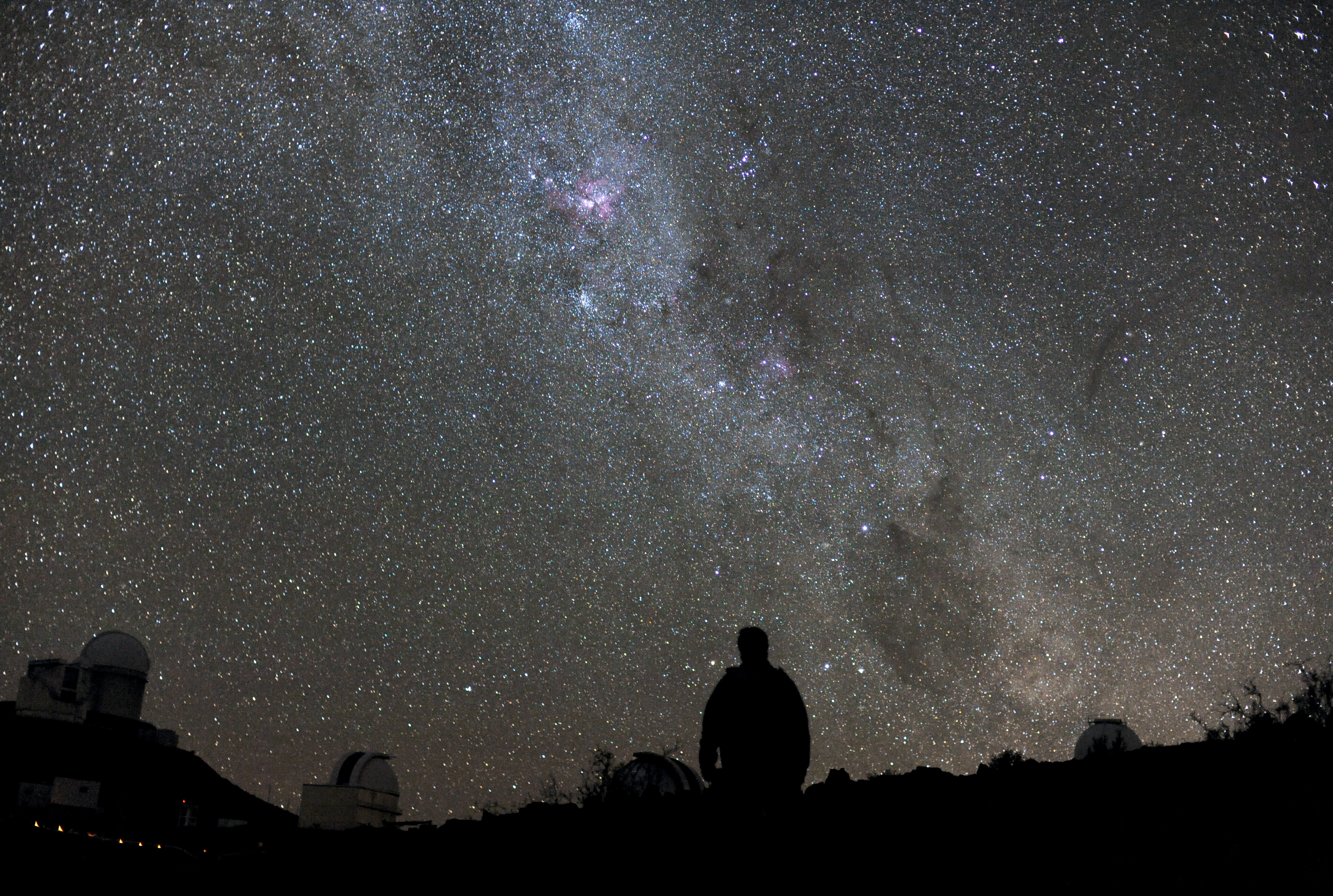
The Milky Way as seen from the La Silla Observatory (Source: Wikipedia)

If there was one thing that has baffled humankind and its imagination the most over several thousands of years, it would undoubtedly be the night sky and the star dust that we all are made of. Starting from the ever changing shape of the dominant moon to the dots that can be joined to form all sorts of shapes (from a crab to a microscope). Don't forget the occasional dropping of the stars!

Isn't it interesting to know that our lives are driven by these objects which are several thousands or millions or trillions of kilometers away? They are also the inspiration for several stories across the world. If we were to prepare a "list of commons" of all civilizations across the world, 2 things would be definitely there on the list - firstly, the human being and second, the study of night sky by the human being (and it wouldn't be an exaggeration).

The Moon - most commonly seen object in the sky (Source: Wikipedia)

The Telescope series will help us improve the understand those little dots and spheres better. So let's calibrate our telescopes for the ride!

Each article of this series is drawn from several sources and they will be highlighted here.