Showing posts with label Gravitational Waves. Show all posts

Wednesday, 20 March 2019

Einstein's Theory of General Relativity

March 20, 1916 - Albert Einstein's Theory of General Relativity was published as an academic paper in Annalen der Physik.

Einstein's Theory of General Relativity

In 1905, Albert Einstein determined that the laws of physics are the same for all non-accelerating observers, and that the speed of light in a vacuum was independent of the motion of all observers. This was the theory of special relativity. It introduced a new framework for all of physics and proposed new concepts of space and time.

Einstein then spent 10 years trying to include acceleration in the theory and published his theory of general relativity in 1915. In it, he determined that massive objects cause a distortion in space-time, which is felt as gravity.
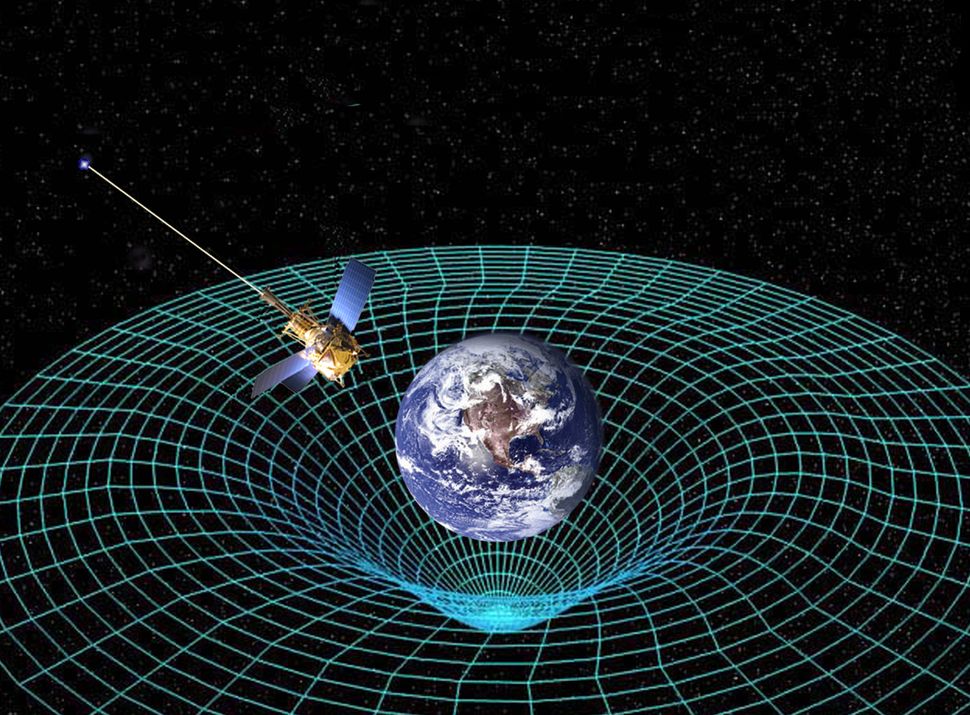
Einstein's theory of general relativity predicted that the space-time around Earth would be not only warped but also twisted by the planet's rotation. Gravity Probe B showed this to be correct.

Gravity
Two objects exert a force of attraction on one another known as "gravity." Sir Isaac Newton quantified the gravity between two objects when he formulated his three laws of motion. The force tugging between two bodies depends on how massive each one is and how far apart the two lie. Even as the center of the Earth is pulling you toward it (keeping you firmly lodged on the ground), your center of mass is pulling back at the Earth. But the more massive body barely feels the tug from you, while with your much smaller mass you find yourself firmly rooted thanks to that same force. Yet Newton's laws assume that gravity is an innate force of an object that can act over a distance.

Albert Einstein, in his theory of special relativity, determined that the laws of physics are the same for all non-accelerating observers, and he showed that the speed of light within a vacuum is the same no matter the speed at which an observer travels. As a result, he found that space and time were interwoven into a single continuum known as space-time. Events that occur at the same time for one observer could occur at different times for another.

As he worked out the equations for his general theory of relativity, Einstein realized that massive objects caused a distortion in space-time. Imagine setting a large body in the center of a trampoline. The body would press down into the fabric, causing it to dimple. A marble rolled around the edge would spiral inward toward the body, pulled in much the same way that the gravity of a planet pulls at rocks in space.

Experimental evidence

Although instruments can neither see nor measure space-time, several of the phenomena predicted by its warping have been confirmed.

Gravitational lensing - Light around a massive object, such as a black hole, is bent, causing it to act as a lens for the things that lie behind it. Astronomers routinely use this method to study stars and galaxies behind massive objects.

Einstein's Cross, a quasar in the Pegasus constellation, is an excellent example of gravitational lensing. The quasar is about 8 billion light-years from Earth, and sits behind a galaxy that is 400 million light-years away. Four images of the quasar appear around the galaxy because the intense gravity of the galaxy bends the light coming from the quasar.
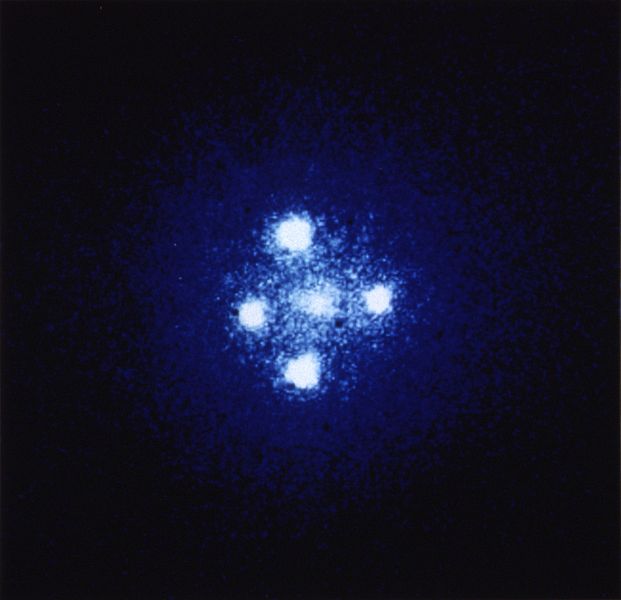
Einstein's Cross is an example of gravitational lensing

Gravitational lensing can allow scientists to see some pretty cool things, but until recently, what they spotted around the lens has remained fairly static. However, since the light traveling around the lens takes a different path, each traveling over a different amount of time, scientists were able to observe a supernova occur four different times as it was magnified by a massive galaxy.

In another interesting observation, NASA's Kepler telescope spotted a dead star, known as a white dwarf, orbiting a red dwarf in a binary system. Although the white dwarf is more massive, it has a far smaller radius than its companion.

Changes in the orbit of Mercury - The orbit of Mercury is shifting very gradually over time, due to the curvature of space-time around the massive sun. In a few billion years, it could even collide with Earth.

Frame-dragging of space-time around rotating bodies - The spin of a heavy object, such as Earth, should twist and distort the space-time around it. Imagine the Earth as if it were immersed in honey. As the planet rotates, the honey around it would swirl, and it's the same with space and time.

In 2004, NASA launched the Gravity Probe B (GP-B). The precisely calibrated satellite caused the axes of gyroscopes inside to drift very slightly over time, a result that coincided with Einstein's theory. GP-B confirmed two of the most profound predictions of Einstein's universe, having far-reaching implications across astrophysics research.

Gravitational red-shift - The electromagnetic radiation of an object is stretched out slightly inside a gravitational field. Think of the sound waves that emanate from a siren on an emergency vehicle; as the vehicle moves toward an observer, sound waves are compressed, but as it moves away, they are stretched out, or red-shifted. Known as the Doppler Effect, the same phenomena occurs with waves of light at all frequencies.

In 1959, two physicists, Robert Pound and Glen Rebka, shot gamma-rays of radioactive iron up the side of a tower at Harvard University and found them to be minutely less than their natural frequency due to distortions caused by gravity.

Gravitational waves - Violent events, such as the collision of two black holes, are thought to be able to create ripples in space-time known as gravitational waves.

In 2016, the Laser Interferometer Gravitational Wave Observatory (LIGO) announced that it found evidence of these tell-tale indicators. In 2014, scientists announced that they had detected gravitational waves left over from the Big Bang using the Background Imaging of Cosmic Extragalactic Polarization (BICEP2) telescope in Antarctica. It is thought that such waves are embedded in the cosmic microwave background. However, further research revealed that their data was contaminated by dust in the line of sight.
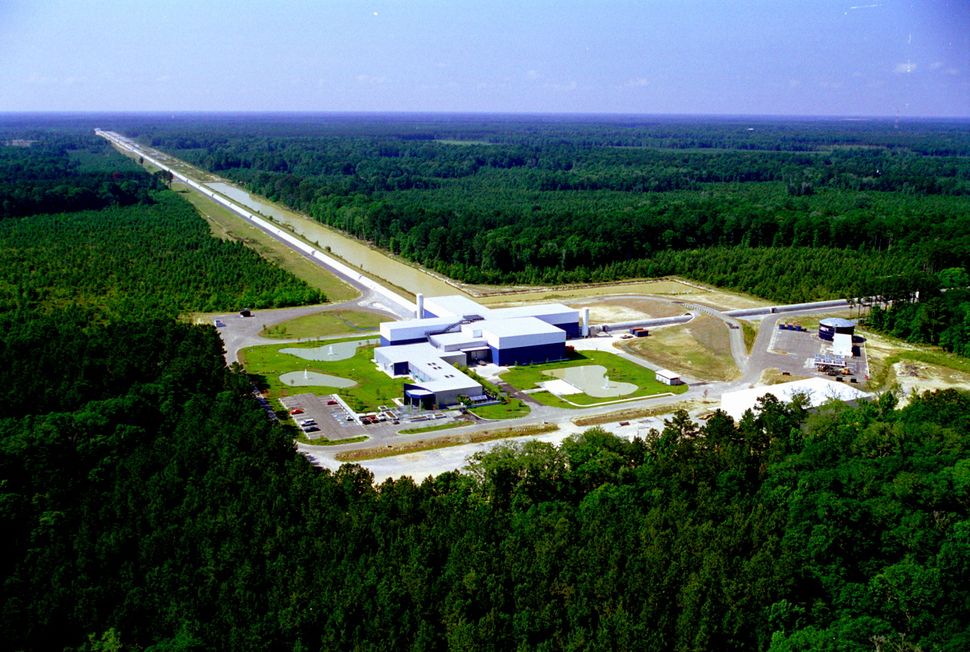
Aerial photo of LIGO Livingston, Louisiana, showing all of one 4 kilometer long arm and part of the other (off to the right). The visible arms are concrete structures that protect the vacuum tubes from the elements.

India is also going to join the hunt for Gravitational Waves by building a gravitational-wave detector that will work in concert with the two detectors currently operating in the United States and a third detector set to come online in Italy. The project could come online as soon as 2023.


Sources -
1. Space.com
2. Wikipedia
3. Pacific Science Center

Wednesday, 24 January 2018

How massive can neutron stars be?

In 2016, when the twin LIGO detectors made their first historic observation of gravitational waves, astronomers heralded the news both as a confirmation of Einstein’s general relativity and also because, as they love to say, the detection opened a new window on the cosmos.

On January 16, 2018, astrophysicists at Goethe University in Frankfurt, Germany described how they used observations of gravitational waves to answer a question that’s plagued scientists since the 1960s, when they first discovered neutron stars, or stars composed predominantly of closely packed neutrons. By definition, a neutron star has a very small radius and very high density (a teaspoon of neutron star material would weigh about 10 million tons). A typical neutron star mass is about 1.4 suns.

Notice all the abouts in those last couple of sentences? Now, for the first time, astrophysicists have succeeded in putting more precision into those numbers, by calculating a strict upper limit for the maximum mass of neutron stars. They say that, with an accuracy of a few percent, the maximum mass of non-rotating neutron stars cannot exceed 2.16 solar masses.

What happens to a neutron star that does exceed its mass limit? In that case, the neutron star collapses into an even more compressed and vastly more exotic object known as a black hole.

Source - EarthSky.org

Monday, 30 October 2017

What are gravitational waves?

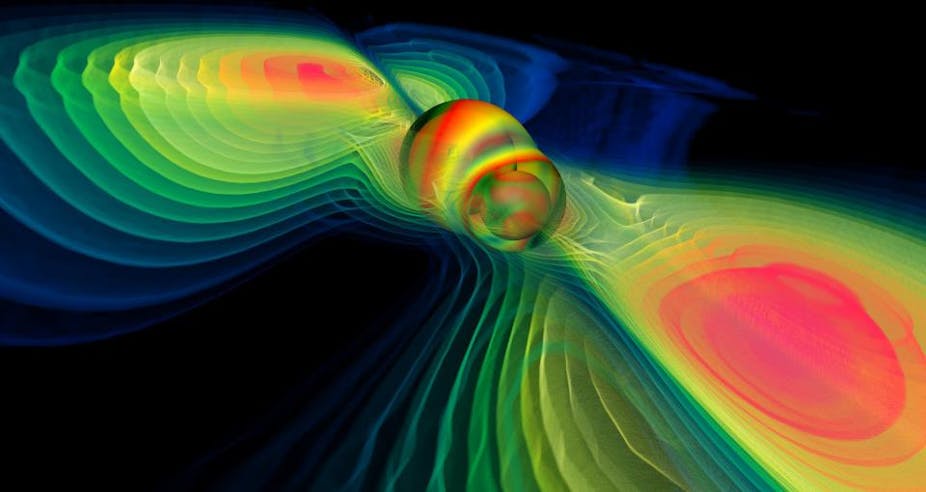
Computer simulation of two merging black holes producing gravitational waves.
Scientists working at the LIGO experiment in the US detected elusive ripples in the fabric of space and time known as gravitational waves. There is no doubt that the finding is one of the most groundbreaking physics discoveries of the past 100 years. But what are they?

To best understand the phenomenon, let’s go back in time a few hundred years. In 1687 when Isaac Newton published his Philosophiæ Naturalis Principia Mathematica, he thought of the gravitational force as an attractive force between two masses – be it the Earth and the Moon or two peas on a table top. However the nature of how this force was transmitted was less well understood at the time. Indeed the law of gravitation itself was not tested until British scientist Henry Cavendish did so in 1798, while measuring the density of the Earth.

Fast forward to 1916, when Einstein presented physicists with a new way of thinking about space, time and gravity. Building on work published in 1905, the theory of general relativity tied together that what we commonly consider to be separate entities – space and time – into what is now called “space-time”.

Space-time can be considered to be the fabric of the universe. That means everything that moves, moves through it. In this model, anything with mass distorts the space-time fabric. The larger the mass, the larger the distortion. And since every moving object moves through space-time, it will also follow the distortions caused by objects with big mass.

One way of thinking about this is to consider two children, one heavier than the other, playing on a trampoline. If we treat the surface of the trampoline as the fabric then the more massive child distorts the fabric more than the other. If one child places a ball near the feet of the other then the ball will roll towards, or follow the distortion, towards their feet. Similarly, when the Earth goes around the sun, the huge mass of the sun distorts the space around it, leaving our comparatively tiny planet following as “straight” a path as it can, but in a curved space. This is why it ends up orbiting the sun.

Trampolines: fun and educational
If we accept this simple analogy, then we have the basics of gravity. Moving on to gravitational waves is a small, but very important, step. Let one of the children on the trampoline pull a heavy object across the surface. This creates a ripple on the surface that can be observed. Another way to visualise it is to consider moving your hand through water. The ripples or waves spread out from their origin but quickly decay.

Any object moving through the space-time fabric causes waves or ripples in that fabric. Unfortunately, these ripples also disappear fairly quickly and only the most violent events produce distortions big enough to be detected on Earth. To put this into perspective, two colliding black holes each with a mass of ten times that of our sun would result in a wave causing a distortion of 1% of the diameter of an atom when it reaches the Earth. On this scale, the distortion is of the order of a 0.0000000000001m change in the diameter of the Earth compared to the 1m change due to a tidal bulge.

What can gravitational waves be used for?

Given that these ripples are so small and so difficult to detect, why have we made such an effort to find them – and why should we care about spotting them? Two immediate reasons come to mind (I’ll leave aside my own interest in simply wanting to know). One is that they were predicted by Einstein 100 years ago. Confirming the existence of gravitational waves therefore provides further strong observational support for his general theory of relativity.

In addition, the confirmation could open up new areas of physics such as gravitational-wave astronomy. By studying gravitational waves from the processes that emitted them – in this case two merging black holes – we could see intimate details of violent events in the cosmos.

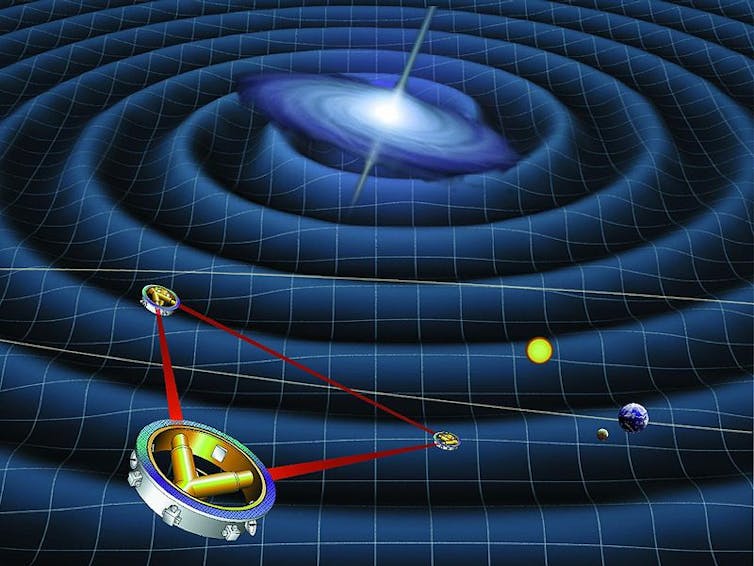
LISA, a planned space-based laser interferometer, could study astrophysical sources of gravitational waves in detail
However, to make the most of such astronomy, it is best to place the detector in space. The Earth-based LIGO managed to catch gravitational waves using laser interferometry. This technique works by splitting a laser beam in two perpendicular directions and sending each down a long vacuum tunnel. The two paths are then reflected back by mirrors to the point they started at, where a detector is placed. If the waves are disturbed by gravitational waves on their way, the recombined beams would be different from the original. However, space-based interferometers planned for the next decade will use laser arms spanning up to a million kilometres.

Now that we know that they exist, the hope is that gravitational waves could open up the door to answering some of the biggest mysteries in science, such as what the majority of the universe is made of. Only 5% of the universe is ordinary matter with 27% being dark matter and the remaining 68% being dark energy, with the latter two being called “dark” as we don’t understand what they are. Gravitational waves may now provide a tool with which to probe these mysteries in a similar way that X-rays and MRI have allowed us to probe the human body.