Showing posts with label Human Beings. Show all posts

Wednesday, 11 April 2018

Raising eyebrows: how evolution gave us expressive faces


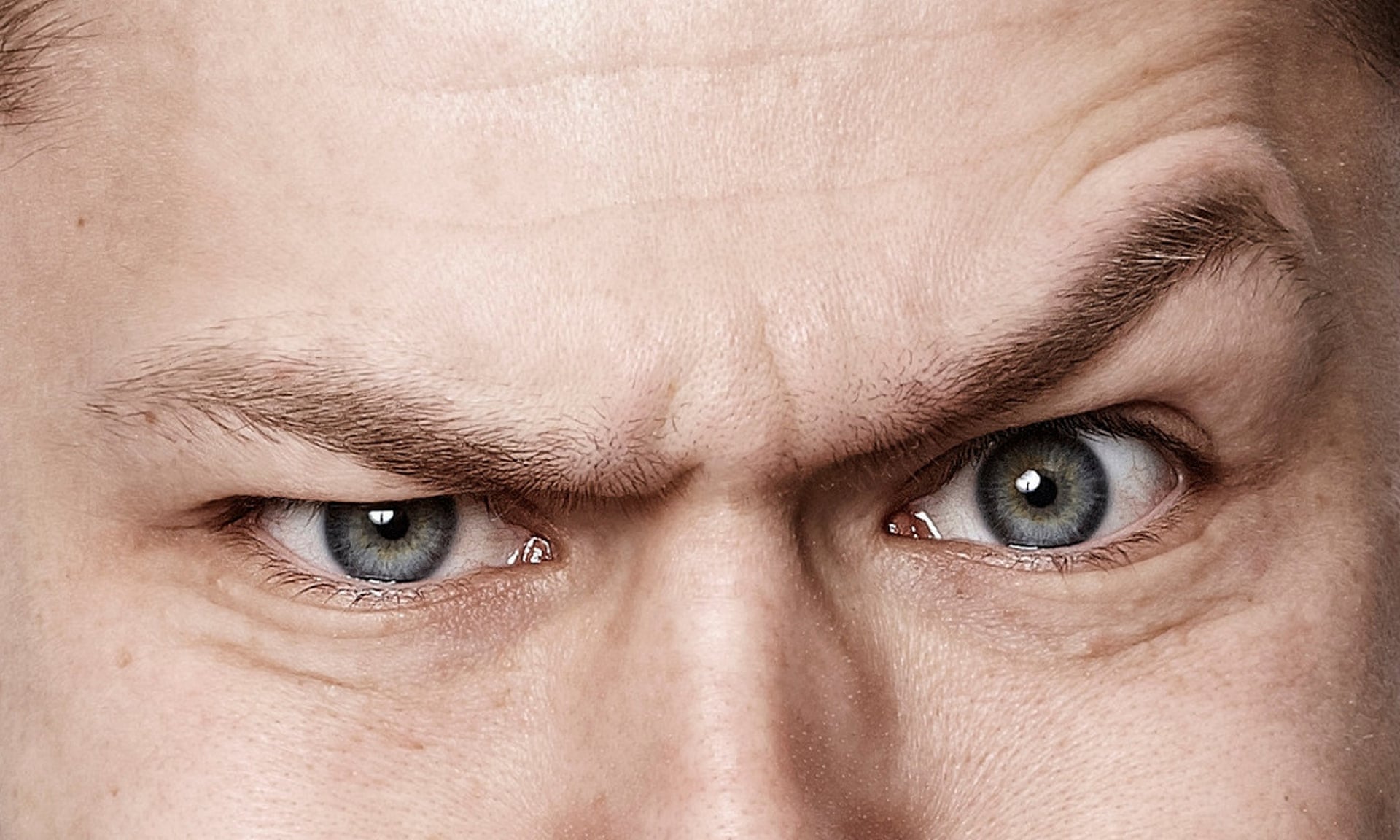
Modern humans might never have raised a quizzical eyebrow had Homo sapiens not lost the thick, bony brows of its ancient ancestors in favour of smoother facial features, a new study suggests.

Researchers at the University of York believe early humans bore prominent brow ridges as a mark of physical dominance, and as the human face evolved to become smaller and flatter, it became a canvas on which the eyebrows could portray a much richer range of emotions. The team stress their conclusions are speculative, but if they are right, the evolution of smaller, flatter faces may have unleashed the social power of the eyebrow, allowing humans to communicate at a distance in more complex and nuanced ways.

We traded dominance or aggression for a wider palette of expression. As the face became smaller and the forehead flattened, the muscles in the face could move the eyebrows up and down and we could express all these subtler feelings. We moved from a position where we wanted to compete, where looking more intimidating was an advantage, to one where it was better to get on with people, to recognize each other from afar with an eyebrow flash, and to sympathize and so on..

The scientists set out to investigate why ancient humans had such prominent brow ridges in the first place. Over the years, researchers have put forward a range of hypotheses. One idea states that the ridge simply filled the gap that would otherwise exist between the protruding face and the braincase. Another argues that a prominent brow served as structural reinforcement, ensuring the face could take the stress of powerful chewing.
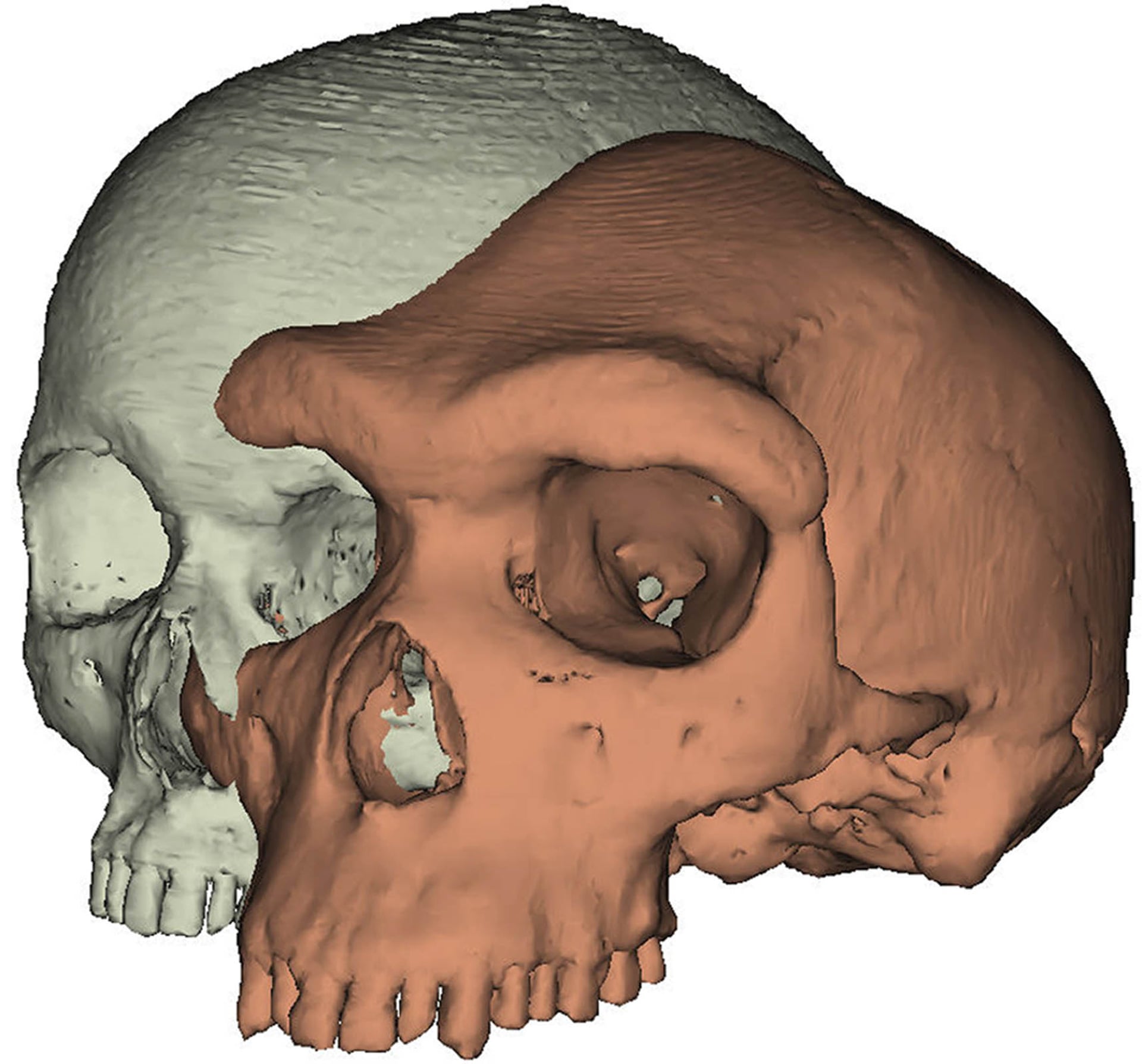
The researchers obtained a 3D x-ray scan of an ancient skull belonging to a human ancestor called Homo heidelbergensis that lived in what is now Zambia between 300,000 and 125,000 years ago. Known as Kabwe 1, the skull displayed a thick brow ridge that was even more prominent than the ones seen on Neanderthals.

A computer generated model of a modern skull next to the heavy-browed skull of ancient hominin Kabwe 1

Using computer models, the scientists performed a series of experiments on the virtual skull. First, they looked at how much brow bone was needed if its purpose was to plug the gap between the face and the braincase. Next, the researchers looked at how the stress of chewing spread over the face with and without the brow ridge. They all seemed to make little difference. What was left was the plausibility of a social explanation.

It is unclear what factors led the human face to become smaller over time and lose its thick brow ridges, but a flatter face may have paved the way for richer human communication and with that the greater collaboration that emerged with the rise of Homo sapiens. In Homo heidelbergensis and other ancestors, the thick brow signified physical strength at the apparent expense of eyebrow gymnastics: in those early humans, the muscles that moved the eyebrows simply pulled them back and forth over their brows.

While one evolutionary psychologist wonders why other primates do not use them more... given the importance of eyebrows in human communication. It is plausible to suggest that it has something to do with increased need for more complex communication in the larger social groups that evolved late during the course of human evolution.

Yet another researcher believes that the human face has many more muscles which are likely to have contributed substantially to the development of socially sophisticated communication, group cohesiveness and functioning, and therefore survival and progress.

Sources -

  1. The Guardian - Science
  2. Nature Ecology & Evolution


Wednesday, 11 October 2017

Can Humans Have Superpowers?


Superheroes are everywhere these days: television shows, blockbuster movies, games. There are even toy-based versions of superheroes, resulting in a perfect storm of merchandising. But while these fictional heroes seem unbelievable, there are actually real superpowers among everyday human beings. These powers are rare, but they can be exploited for their incredible abilities.

Superpowers are real. There are documented cases of human beings displaying amazing abilities such as an extremely detailed memory, seeing sound as colour or even magnetism. Usually there is some genetic explanation: The people with magnetism seem to have a higher friction on their skin, making it attractive not only to metal but also glass, plastic and wood.

Liam Hoekstra, the world's strongest kid, could do a pullup by the time he was 8 months old. His body wasn't producing myostatin, a gene that inhibits muscular growth. Without it, there is no limit to muscle development, leading to real-life super strength.

Other superpowers heighten certain senses to an extreme degree. Synaesthesia, common in many artists and musicians, is where experiencing one sense leads to experiencing another. (For example, you might always "see" a certain letter as a certain colour.) Many people with synaesthesia also have chromesthesia, which enables them to see sound as colour.

Some superpowers can even be learned: Echolocation, for example, is the ability to sense where objects are in space by detecting how sound bounces off them. Bats and dolphins have this ability, and so do humans. Ben Underwood learned echolocation to play football, basketball, skateboard and rollerblade, all without the use of his eyes. People can also learn to regulate their body temperature through a method called tummo-meditation. Wim Hof, aka "The Iceman," learned how and was able to climb Mount Everest wearing only shorts and shoes by employing tummo techniques to keep him warm.

So human beings are pretty cool! But here's the scary part: Where there are superheroes, there must also be supervillains. And many times, supervillains are organized. What happens when private entities, like pharmaceutical companies, have the technology to create and manufacture superpowers? There are obvious concerns like super soldiers, but there are more insidious factors as well.

Diana Brown "Can Humans Have Superpowers?" HowStuffWorks.com.