Showing posts with label Sun. Show all posts

Saturday, 10 March 2018

Send your name to the sun


NASA’s Parker Solar Probe mission – scheduled to launch in summer 2018 – will travel through the sun’s atmosphere and get closer to the solar surface than any spacecraft before it. You can send your name along for the ride.

To commemorate humanity’s first visit to our own star, NASA is inviting people around the world to submit their names online to be placed on a microchip aboard the Parker Solar Probe. Submissions will be accepted until April 27, 2018. Learn more and add your name to the mission here. Link to register your name
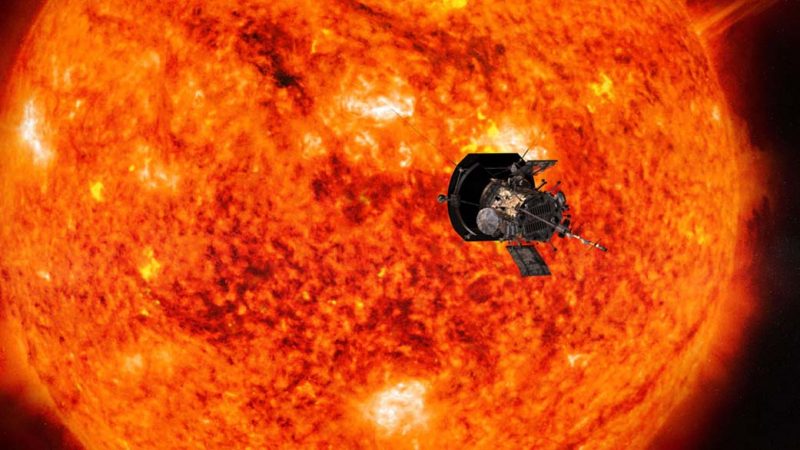
Illustration of the Parker Solar Probe spacecraft approaching the sun

The spacecraft, about the size of a small car, will travel directly into the sun’s atmosphere about 4 million miles (6.4 million km) from its surface. The primary science goals for the mission, said NASA, are to trace how energy and heat move through the solar corona and to explore what accelerates the solar wind as well as solar energetic particles.

The spacecraft speed is so fast, at its closest approach it will be going at approximately 430,000 miles (692,000 km) per hour. That’s fast enough to get from Washington, D.C., to Tokyo in under a minute.
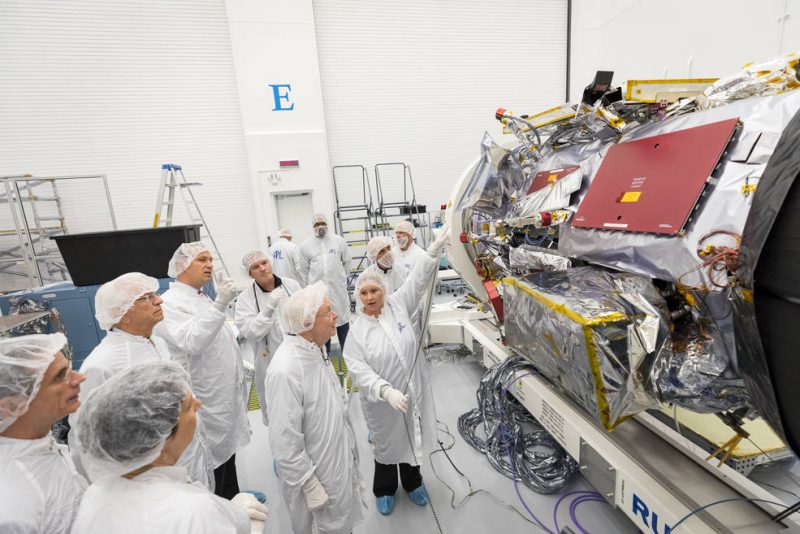
NASA named the spacecraft the Parker Solar Probe in honor of astrophysicist Eugene Parker. This was the first time NASA named a spacecraft for a living individual. In this photo, Eugene Parker, professor emeritus at the University of Chicago, visits the spacecraft that bears his name on October 3, 2017. Engineers in the clean room at the Johns Hopkins Applied Physics Laboratory in Laurel, Maryland, where the probe was designed and built, point out the instruments that will collect data as the mission travels directly through the sun’s atmosphere.

To perform its investigations, the spacecraft and instruments will be protected from the sun’s heat by a 4.5-inch-thick (11.4 cm) carbon-composite shield, which will need to withstand temperatures outside the spacecraft that reach nearly 2,500 degrees Fahrenheit (1,371 degrees C). This heat shield will keep the four instrument suites designed to study magnetic fields, plasma and energetic particles, and image the solar wind, at room temperature.
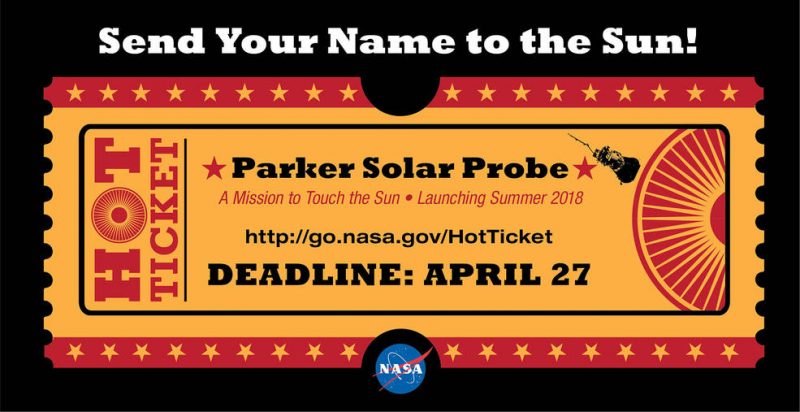
Send your name to the sun, via a microchip installed on NASA’s upcoming Parker Solar Probe mission. Submissions will be accepted until April 27, 2018.


Sources -
  1. NASA
  2. EarthSky.org

Wednesday, 8 November 2017

Will Earth undergo 15 days of darkness in November 2017?


The days-of-darkness online hoax is back! Do these hoaxes ever die? No, Earth will not experience 15 days of darkness in November, 2017.

Did NASA announce it? No.

Will it happen? No.

YouTube videos are suggesting the event will be caused by “another astronomical event, between Venus and Jupiter.” Yes, Jupiter and Venus – the sky’s two brightest planets – are having a conjunction low in the east before dawn this month. It’ll be beautiful! It’s just so wrong to use this conjunction – which has happened countless times in Earth history, to the wonderment of all privileged to observe it – to perpetuate a hoax.

As for the idea that NASA has issued a “1,000-page document” on the event for the White House. Well. That’s just entirely fake.

Think about it. What would have to happen for Earth to experience 15 days of darkness? Our day-night cycle stems from Earth’s rotation on its axis around our local star, the sun. The sun shines on half of Earth for part of its 24-hour period; that’s daytime. Nighttime is simultaneously occurring on the opposite side of Earth.

For the whole Earth to undergo 15 days of darkness … what would have to happen? The sun would have to go out for 15 days? Or something would have to shroud the sun? Or pass between us and the sun?

All of those scenarios are unlikely to the point of ridiculousness, when you consider the vast size of our sun. That’s why zero days of all-Earth darkness have occurred in human history so far.

It’s never happened. It’s not going to happen.

This same hoax has been rearing its head every few years, since at least 2011, when the erstwhile Comet Elenin was supposed to pass between us and the sun and cause three days of darkness. In 2014, the number of supposed “dark days” increased to six.

In 2015, an article at Newswatch33 suggested NASA confirmation for 15 days of darkness between November 15 and November 29 of that year. The article said that – according to NASA – such an event hadn’t occurred in over 1 million years.

There were zero days of all-Earth darkness in November, 2015.

So. It didn’t go dark in 2011, 2014, or 2015, and it’s not going to go dark for 15 days in November this year.

It’s interesting that these “days of darkness” rumors all spring up around November and December, when the northern half of Earth is edging toward its winter solstice and shortest day of the year. Let’s face it, it’s darker out there now for us on this half of the globe. Just remember … it’s a natural kind of darkness, a resting kind of darkness.

In fact, for the Northern Hemisphere, the earliest sunsets of the year come in early December. After the solstice, for sure by early January, the longer days will be returning very noticeably as we move toward spring and rebirth.

That’s nature’s cycle, and we can depend on it!

Source - EarthSky.org

Sunday, 8 October 2017

What if photosynthesis stopped happening?

Photosynthesis converts light energy to chemical energy. Essentially, photosynthesis is the fueling process that allows plants and even algae to survive and grow. So what would happen if photosynthesis suddenly stopped happening?


If photosynthesis came to an abrupt end, most plants would die within short order. Although they could hold out for a few days -- or in some cases, a few weeks -- how long they lived would largely be a factor of how much sugar they had stored within their cells.

Large trees, for example, may be able to soldier on for several years — perhaps even a few decades — because of their energy stores and the slow rate of use. However, the majority of plants would meet a withering end, and so would the animals that rely on them for nourishment. With all the herbivores dead, the omnivores and carnivores would soon follow. Although these meat-eaters could feed on all the carcasses strewn about, that supply wouldn't last more than a few days. Then the animals that temporarily relied on them for sustenance would die.

That's because for photosynthesis to cease to exist, Earth would have to plunge into darkness. To do this, the sun would have to disappear and plunge Earth's surface temperatures into a never-ending winter of bitter cold temperatures. Within a year, it would bottom out at minus 73 degrees Celsius, resulting in a planet of purely frozen tundra.

Ironically, if the sun burned too bright, it could cause photosynthesis to stop occurring. Too much light energy would damage plants' biological structure and prevent photosynthesis from happening. This is why the photosynthetic process, in general, shuts down during the hottest hours of the day.

Whether the culprit were too much sunlight or not enough, if photosynthesis stopped, plants would stop converting carbon dioxide -- an air pollutant -- to organic material. Right now, we rely on photosynthetic plants, algae and even bacteria to recycle our air. Without them, there would be less oxygen production.

Even if all the plants on Earth were to die, people would remain resourceful -- especially if their lives depended on it. An artificial photosynthesis process being developed by scientists could just become the world's biggest problem-solver. Using an artificial "leaf," scientists have successfully harnessed sunlight and recreated photosynthesis. The leaf is actually a silicon solar cell that, when put in water and exposed to light, then generates oxygen bubbles from one side and hydrogen bubbles from the other - essentially splitting oxygen and hydrogen. Although the idea was designed as a way to potentially produce clean energy, there are implications for recreating a photosynthetic atmosphere as well.

Source - Laurie L. Dove "What if photosynthesis stopped happening?" 1 June 2015.
HowStuffWorks.com.

Friday, 6 October 2017

ISS transits the sun and the moon


Is it a bird? Is it a plane? No, it is the International Space Station as it flies in front of the moon as seen from ESA's space science centre near Madrid, Spain, on 14 January.

A full moon, looking up at the right time and good weather are necessary to take a picture like this. Consisting of 13 superimposed images, it clearly shows the station's main elements. Thirteen frames were captured starting at 01:01:14 GMT, with the Station taking just half a second to cross the moon. The outpost is the largest structure in orbit, spanning the size of a football pitch, but at 400 km altitude it still appears tiny through a telescope.

As the station could be seen only when in front of the moon, the group had to press the shutter and hope for the best. Their calculations were perfect and the result speaks for itself.


Taking an image of the International Space Station as it passes in front of the Sun, Moon or planets is a popular pastime for astrophotographers. It requires planning, patience and a measure of luck. The camera must be set up at the right time in the right place to capture the Space Station as it flies past at 28 800 km/h. At such speeds the photographer has only seconds to capture the transit and if any clouds block the view it has to wait for another opportunity weeks later.

This photograph was taken by the astronomy club at ESA's European Space Astronomy Centre near Madrid in 2013. Although there were clear skies, a bird flew overhead in the 1.2 seconds it took the Station to pass in front of the Sun.

The Station flies around Earth at around 400 km, allowing the astronomy club to calculate that the bird was flying 86 m from the camera lens. The difference in size and distance makes both the bird and the Space Station appear the same size.

Source - European Space Agency and Phys.org