Showing posts with label Moon. Show all posts

Thursday, 31 January 2019

Can moons have moons?

A new study shows that Earth’s moon should, theoretically, be able to have its own moon. Why doesn’t it?

Size comparison of the major moons in our solar system 

Most of the planets in our solar system have orbiting moons, and even some asteroids have their own moons. But do any moons have moons? Is it possible? Could there be so-called submoons?

It’s a simple enough question. If most other objects in the solar system can have moons, why not moons themselves? Researchers decided to try to answer this question of a 4 year old. Their results have now been published in a new peer-reviewed paper in the February 2019 issue of the Monthly Notices of the Royal Astronomical Society.

Planets orbit stars and moons orbit planets, so it is natural to ask if smaller moons could orbit larger ones. So far at least, no submoons have been found orbiting any of the moons considered most likely to support them – Jupiter’s moon Callisto, Saturn’s moons Titan and Iapetus and Earth’s own moon.

The lack of known submoons in our solar system, even orbiting around moons that could theoretically support such objects, can offer us clues about how our own and neighboring planets formed, about which there are still many outstanding questions.
Earth’s moon should theoretically be able to have its own moon. Why doesn’t it?

Researchers found that only large moons on wide orbits from their host planets would be capable of hosting submoons. Usually, any submoons orbiting smaller moons closer to their planet would have their orbits destabilized by tidal forces. Jupiter’s large moon Callisto, Saturn’s large moon Titan, another Saturn moon called Iapetus and Earth’s moon could all theoretically have submoons, so why don’t they?

There may be other sources of submoon instability, such as the non-uniform concentration of mass in Earth’s moon’s crust.

Part of the answer might also have to do with how the primary moons formed in the first place. Earth’s moon is thought to have been born out of a collision between Earth and another body about the size of Mars – and that collision may have helped life on Earth to get started. But some other moons, like those orbiting Jupiter and Saturn, originated from the same cloud of gas and dust that the planets themselves formed from.
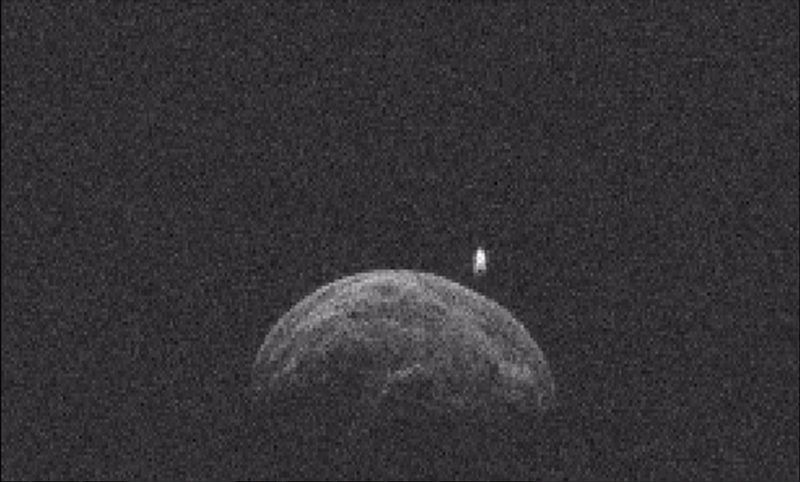
Even asteroids can have moons, such as 2004 BL86. It is about 325 meters in diameter, and its moon is tiny, only 70 meters wide.

It may be that in many or even most cases, there are multiple factors that make the orbits of submoons inherently unstable. Knowing whether that is true or not may have to wait for discoveries of moons orbiting distant exoplanets. Moons themselves are much harder to detect and only one promising candidate has been found so far – a possible exomoon orbiting the Jupiter-sized exoplanet Kepler-1625b. That possible moon – about the size of Neptune – is large enough and far enough from its planet that submoons should be possible as well. Astronomers will need to verify that primary moon first – if it does exist – before looking for any submoons.

Even though Earth’s moon doesn’t have a submoon now, it may in the future, according to the researchers – an artificial one, perhaps NASA’s planned Lunar Gateway. The Lunar Gateway would help to establish humanity’s presence in deep space.

The possibility of moons having their own moons is a fascinating one, even though we haven’t found any examples yet. This new research from Carnegie Science shows that it is indeed possible, but only under the right circumstances.

Download the research paper here.

Adapted from EarthSky.org

Sunday, 25 November 2018

Why does a full moon look full?

Remember that half the moon is always illuminated by the sun. That lighted half is the moon’s day side.

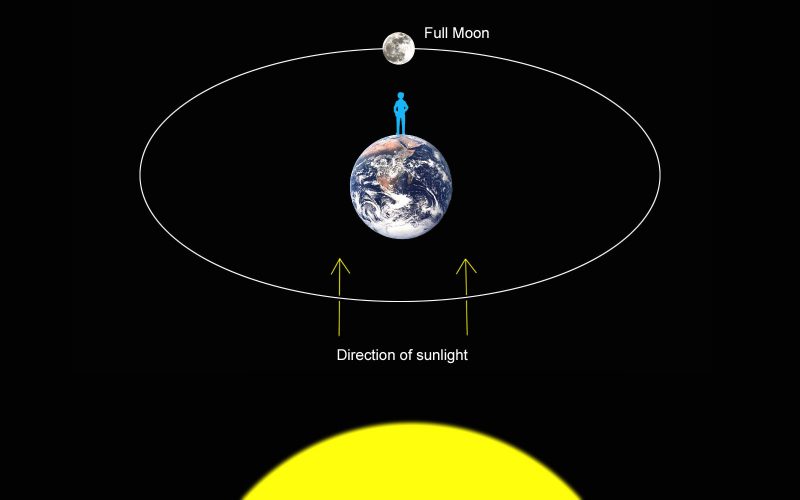
Technically speaking, the moon is full at the instant it’s 180 degrees from the sun in ecliptic longitude. So why does a full moon look full? Remember that half the moon is always illuminated by the sun. That lighted half is the moon’s day side.

In order to appear full to us on Earth, we have to see the entire day side of the moon. That happens only when the moon is opposite the sun in our sky. So a full moon looks full because it’s opposite the sun.

That’s also why every full moon rises in the east around sunset – climbs highest up for the night midway between sunset and sunrise (around midnight) – and sets around sunrise. Stand outside tonight around sunset and look for the moon. Sun going down while the moon is coming up? That’s a full moon, or close to one.

Just be aware that the moon will look full for at least a couple of night around the instant of full moon.

A full moon is opposite the sun. We see all of its dayside.
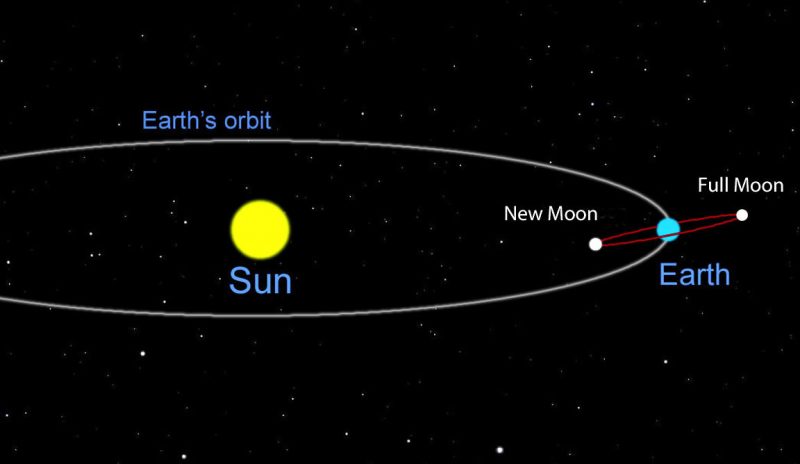
If a full moon is opposite the sun, why doesn’t Earth’s shadow fall on the moon at every full moon? The reason is that the moon’s orbit is titled by 5.1 degrees with respect to Earth’s orbit around the sun. At every full moon, Earth’s shadow sweeps near the moon. But, in most months, there’s no eclipse.

A full moon normally passes above or below Earth’s shadow, with no eclipse.
Source - EarthSky.org

Sunday, 21 October 2018

Chinese city 'plans to launch artificial moon to replace streetlights'

In Chengdu, there is reportedly an ambitious plan afoot for replacing the city’s streetlights: boosting the glow of the real moon with that of a more powerful fake one.

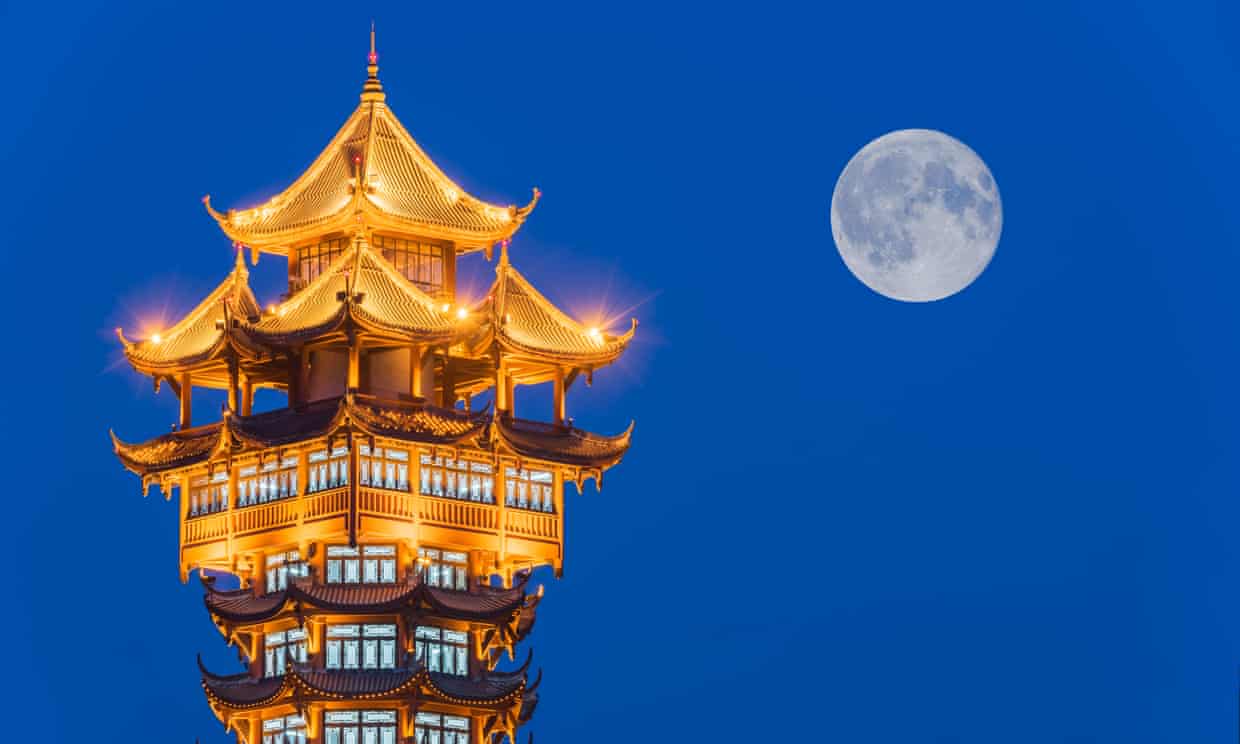
Jiutian Tower illuminated at night with full moon in the background, Chengdu, China

The south-western Chinese city plans to launch an illumination satellite in 2020. According to an account in the People’s Daily, the artificial moon is “designed to complement the moon at night”, though it would be eight times as bright. The “dusk-like glow” of the satellite would be able to light an area with a diameter of 10-80km, while the precise illumination range could be controlled within tens of metres – enabling it to replace streetlights.

The vision was shared by Wu Chunfeng, the chairman of the private space contractor Chengdu Aerospace Science and Technology Microelectronics System Research Institute Co (Casc). Wu reportedly said testing had begun on the satellite years ago and the technology had now evolved enough to allow for launch in 2020.

The People’s Daily report credited the idea to “a French artist, who imagined hanging a necklace made of mirrors above the Earth which could reflect sunshine through the streets of Paris all year round”.

The likelihood of Chengdu’s fake moon rising remains to be seen. But there are precedents for this moonage daydream rooted in science, though the technology and ambitions differ.

In 2013 three large computer-controlled mirrors were installed above the Norwegian town of Rjukan to track the movement of the sun and reflect its rays down on the town square. (Read more at Rjukan sun: the Norwegian town that does it with mirrors)

Longer ago, in the 1990s, a team of Russian astronomers and engineers succeeded in launching a satellite into space to deflect sunlight back to Earth, briefly illuminating the night-time hemisphere. The Znamya experiment was to “test the feasibility of illuminating points on Earth with light equivalent to that of several full moons”, the New York Times said. “Several” proved an overstatement, but the design was shown to be sound. (Read more at Russians to Test Space Mirror as Giant Night Light for Earth)

A more ambitious attempt, Znamya 2.5, was made in 1999, prompting preemptive concerns about light pollution disrupting nocturnal animals and astronomical observation. But Znamya 2.5 misfired on launch and its creators failed to raise funding for another attempt.

The People’s Daily was quick to reassure those concerned about the fake moon’s impact on night-time wildlife. Kang Weimin, director of the Institute of Optics, School of Aerospace, Harbin Institute of Technology, explains that, "the light of the satellite is similar to a dusk-like glow, so it should not affect animals’ routines”.

Let's wait and see..

Source - The Guardian

Wednesday, 18 July 2018

Astronomers discover 12 new moons orbiting Jupiter

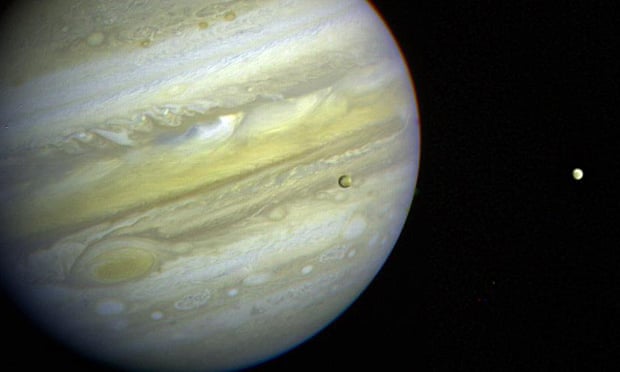
 Photograph showing two of Jupiter’s 79 moons
One of a dozen new moons discovered around Jupiter is circling the planet on a suicide orbit that will inevitably lead to its violent destruction, astronomers say.

Researchers in the US stumbled upon the new moons while hunting for a mysterious ninth planet that is postulated to lurk far beyond the orbit of Neptune, the most distant planet in the solar system. The team first glimpsed the moons in March last year from the Cerro Tololo Inter-American Observatory in Chile, but needed more than a year to confirm that the bodies were locked in orbit around the gas giant.

Jupiter, the largest planet in the solar system, was hardly short of moons before the latest findings. The fresh haul of natural satellites brings the total number of Jovian moons to 79, more than are known to circle any other planet in our cosmic neighbourhood.

Astronomers have discovered twelve new moons orbiting Jupiter, bringing the total number of Jovian moons to 79.

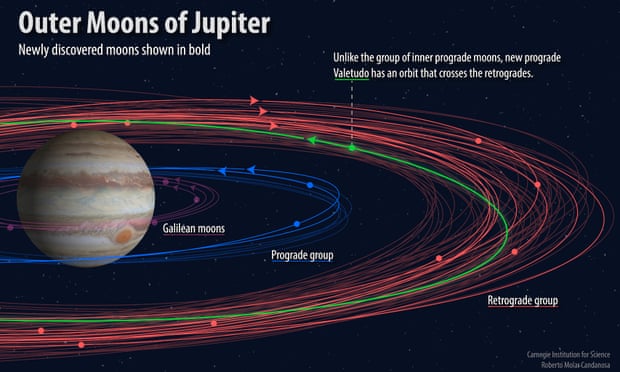
Nine of the new moons belong to an outer group that orbit Jupiter in retrograde, meaning they travel in the opposite direction to the planet’s spin. They are thought to be the remnants of larger parent bodies that were broken apart in collisions with asteroids, comets and other moons. Each takes about two years to circle the planet.

Two more of the moons are in a group that circle much closer to the planet in prograde orbits which travel in the same direction as Jupiter’s spin. Most likely to be pieces of a once larger moon that was broken up in orbit, they take nearly a year to complete a lap around Jupiter. Which direction the moons swing around the planet depends on how they were first captured by Jupiter’s gravitational field.

Astronomers describe the twelfth new Jovian moon as an “oddball”. Less than a kilometre wide, the tiny body circles Jupiter on a prograde orbit but at a distance that means it crosses the path of other moons hurtling towards it. Scientists have named the new moon Valetudo after the Roman god Jupiter’s great-granddaughter, the goddess of health and hygiene. Collisions aren't frequent and this particular one is also unlikely to happen anytime soon. If it does happen, it can definitely be observed from Earth.

The team suspects that Valetudo is the final remnant of a once much larger moon that has been ground to dust by collisions in the past. Which raises the question of how long the tiny moon has left.


Reference - The Guardian

Read more at the Science Pole App

Wednesday, 24 January 2018

No double moon in 2018, or ever

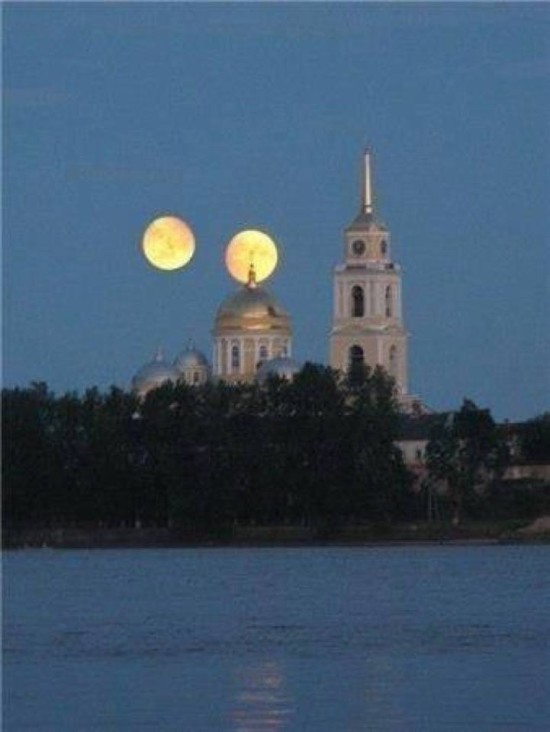
This image sometimes circulates on Facebook, with the claim that Mars will appear as big and bright as a full moon. It’s a hoax. Don’t believe it.

Will Mars and the moon will appear the same size in 2018? No. What’s really amazing is the staying power of this hoax, which has its roots in a real 15-year cycle of Mars, that’s peaking – giving us an excellent year to observe Mars – in 2018.

We are likely to see it as an email – or on social media – in the form of a claim that Mars will appear as large as a full moon in Earth’s sky on a particular date. Sometimes there’s a suggestion that Mars and Earth’s moon will appear as a double moon. And that is just not true. It’s not true in 2018. It’s never been true. It never will be true.

Mars can never appear as large as a full moon as seen from Earth. As seen from Earth, in months when Mars does appear side by side with a full moon, Mars’ diameter appears, on average, about 1/140th the diameter of the full moon.

Mars is the planet orbiting the Sun one step outward from Earth’s orbit and is slightly smaller than Earth – but slightly larger than Earth’s moon. Mars is also much much farther away than Earth’s moon. It’s hard to comprehend what little specks the planets and moons are in contrast to the vastness of space.

Earth’s moon is about a light-second away. Light bouncing from the moon’s surface takes about a second to reach us here on Earth. Meanwhile, light from Mars takes much much longer to reach Earth – from several minutes to about 20 minutes – with the difference being the result of Earth’s and Mars’ motions around the sun. In other words, when Mars is on the same side of the sun as Earth, its distance from us is less than when it’s on the far side of the sun from us.

The moon is much closer than Mars, and that’s why we see the moon as a bright disk in our sky. Meanwhile – to the eye – Mars appears as a reddish star-like point.

So how did this rumor of Mars-as-big-and-bright-as-the-moon get started? It started in 2003. On 27th August 2003, Earth and Mars came very slightly closer than they’d been in nearly 60,000 years. Center-to-center, Earth and Mars were less than 35 million miles apart – just over three light-minutes apart. The last people to come so close to Mars were Neanderthals. Astronomy writers had a field day that year, talking about Mars at its closest.

Was it a spectacular sight? Yes! Mars looked like a dot of flame in the night sky. Was Mars as big and bright as the moon, even at its closest in 2003? Never.

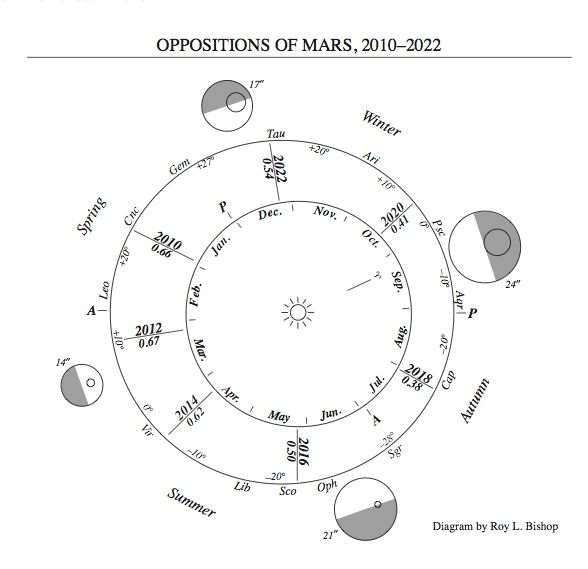
The 2003 event was part of a 15-year cycle for Mars. Think of Earth and Mars in orbit around the sun again. Neither Earth nor Mars has a circular orbit. Both worlds have elliptical orbits. So both Earth and Mars have a closest point to the sun. When Earth passes between the sun and Mars (opposition) around the time Mars is closest to the sun (perihelion) – Earth and Mars come closest.

Diagram by Roy L. Bishop. Copyright Royal Astronomical Society of Canada. This diagram explains why, in 2016, Mars was closer than it had been in 10 years. In 2018, it’ll be even closer … but never moon-sized in Earth’s sky.
If we look closely at this diagram, we can see that Earth and Mars will have a particularly close opposition in mid-2018. Mars will be closer than it’s been since 2003!

It’ll be bright and very reddish but only like a dot of flame.

Source - EarthSky.org

Thursday, 4 January 2018

What is a blue moon?


A blue moon is an additional full moon that appears in a subdivision of a year: either a second full moon in a month of the common calendar or the third of four full moons in a season.

The phrase has nothing to do with the actual color of the moon, although a literal "blue moon" (the moon appearing with a tinge of blue) may occur in certain atmospheric conditions: e.g., if volcanic eruptions or fires leave particles in the atmosphere of just the right size to preferentially scatter red light.

On January 31, the moon will be full for the second time in a month, a rare occasion—it happens once every two and a half years.

Monday, 30 October 2017

Wayward moon is receding from Earth


From 1969 to 1972, Apollo astronauts had left laser reflectors on the moon’s surface, enabling astronomers to measure the moon’s distance from Earth with great accuracy. Although the moon’s distance from earth varies each month because of its eccentric orbit, the moon’s mean distance from Earth is nonetheless increasing at the rate of about 3.8 centimeters (1.5 inches) per year. That’s about the rate that fingernails grow.

Tidal friction with the Earth’s oceans is responsible for this long-term increase of the moon’s distance from Earth. It’s causing the moon to spiral into a more distant orbit. Tidal friction also slows down the Earth’s rotation, lengthening the day by about 1 second every 40,000 years. Hence, the number of days in a year is slowly diminishing over the long course of time.

Simulations suggest that at the time of the moon’s formation some 4.5 billion years ago, the moon was only about 20,000 to 30,000 kilometers from Earth. Way back then, Earth’s day might have been only 5 or 6 hours long. That would mean over 1,400 days in one year!

The Apollo 11 lunar laser ranging retroreflector array on the moon.
However, astronomers suspected the moon was receding from Earth before the heyday of the Apollo astronauts. Edmund Halley’s (1656 to 1741) studies of ancient solar and lunar eclipses suggested the possibility, as well. George Howard Darwin (1845 to 1912) is credited for figuring out mathematically how tidal friction affects the moon’s orbit.

Studies in fossilized coral indicate that the Earth had spun faster upon its rotational axis when the moon was closer to Earth. Millions of years ago, days on Earth were shorter yet more abundant. For instance, around 900 million years ago, there were about 480 18-hours days in one year. Around 400 million years ago, there were about 400 22-hour days in one year. Looking into the future, astronomers expect longer days but fewer of them in one year.

If the lifetime of the Earth-moon system lasts long enough (which is doubtful), it is projected that after many billions of years, the same sides of the Earth and moon would face one another. In other words, the Earth’s rotational period and the moon’s orbital period would equal one another, representing a period of 47 days. At that time, the Earth/moon distance would expand to some 560,000 km, exceeding the present distance of 384,400 km by nearly 150%.

Source - EarthSky.org

Friday, 6 October 2017

ISS transits the sun and the moon


Is it a bird? Is it a plane? No, it is the International Space Station as it flies in front of the moon as seen from ESA's space science centre near Madrid, Spain, on 14 January.

A full moon, looking up at the right time and good weather are necessary to take a picture like this. Consisting of 13 superimposed images, it clearly shows the station's main elements. Thirteen frames were captured starting at 01:01:14 GMT, with the Station taking just half a second to cross the moon. The outpost is the largest structure in orbit, spanning the size of a football pitch, but at 400 km altitude it still appears tiny through a telescope.

As the station could be seen only when in front of the moon, the group had to press the shutter and hope for the best. Their calculations were perfect and the result speaks for itself.


Taking an image of the International Space Station as it passes in front of the Sun, Moon or planets is a popular pastime for astrophotographers. It requires planning, patience and a measure of luck. The camera must be set up at the right time in the right place to capture the Space Station as it flies past at 28 800 km/h. At such speeds the photographer has only seconds to capture the transit and if any clouds block the view it has to wait for another opportunity weeks later.

This photograph was taken by the astronomy club at ESA's European Space Astronomy Centre near Madrid in 2013. Although there were clear skies, a bird flew overhead in the 1.2 seconds it took the Station to pass in front of the Sun.

The Station flies around Earth at around 400 km, allowing the astronomy club to calculate that the bird was flying 86 m from the camera lens. The difference in size and distance makes both the bird and the Space Station appear the same size.

Source - European Space Agency and Phys.org

Friday, 15 April 2016

1. Telescope - Let's calibrate!

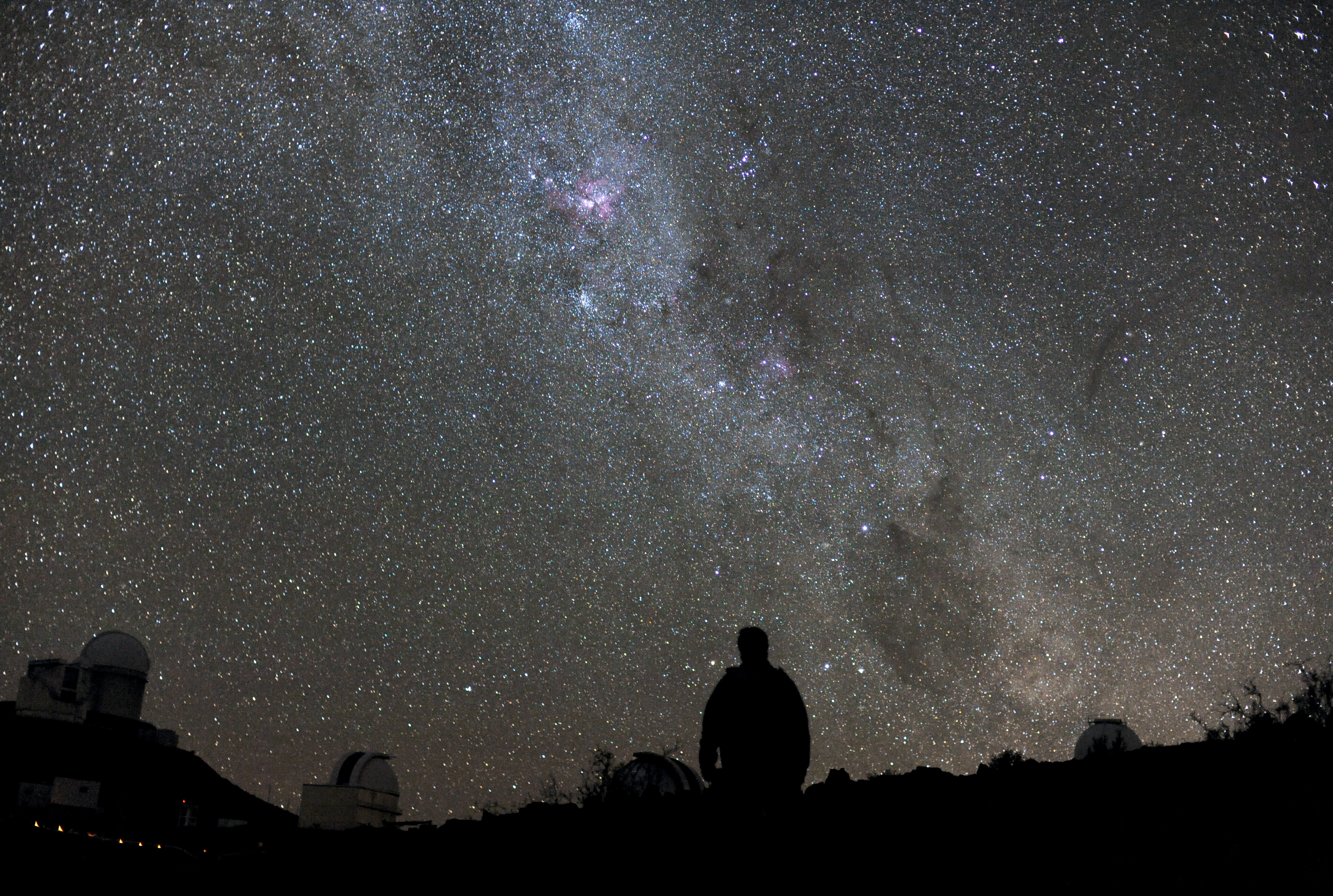
The Milky Way as seen from the La Silla Observatory (Source: Wikipedia)

If there was one thing that has baffled humankind and its imagination the most over several thousands of years, it would undoubtedly be the night sky and the star dust that we all are made of. Starting from the ever changing shape of the dominant moon to the dots that can be joined to form all sorts of shapes (from a crab to a microscope). Don't forget the occasional dropping of the stars!

Isn't it interesting to know that our lives are driven by these objects which are several thousands or millions or trillions of kilometers away? They are also the inspiration for several stories across the world. If we were to prepare a "list of commons" of all civilizations across the world, 2 things would be definitely there on the list - firstly, the human being and second, the study of night sky by the human being (and it wouldn't be an exaggeration).

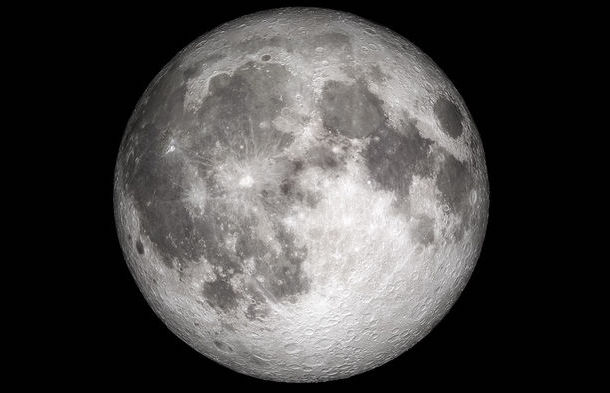
The Moon - most commonly seen object in the sky (Source: Wikipedia)

The Telescope series will help us improve the understand those little dots and spheres better. So let's calibrate our telescopes for the ride!

Each article of this series is drawn from several sources and they will be highlighted here.