Showing posts with label Jupiter. Show all posts

Wednesday, 18 July 2018

Astronomers discover 12 new moons orbiting Jupiter

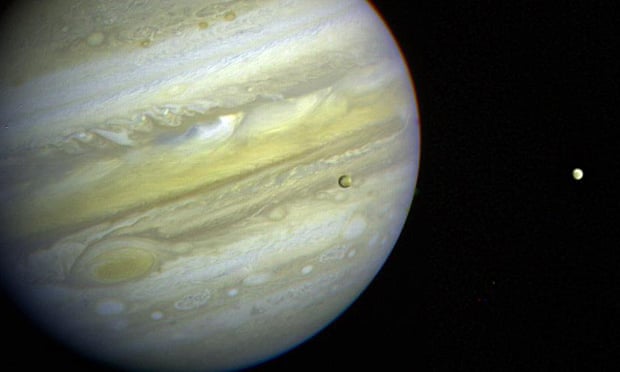
 Photograph showing two of Jupiter’s 79 moons
One of a dozen new moons discovered around Jupiter is circling the planet on a suicide orbit that will inevitably lead to its violent destruction, astronomers say.

Researchers in the US stumbled upon the new moons while hunting for a mysterious ninth planet that is postulated to lurk far beyond the orbit of Neptune, the most distant planet in the solar system. The team first glimpsed the moons in March last year from the Cerro Tololo Inter-American Observatory in Chile, but needed more than a year to confirm that the bodies were locked in orbit around the gas giant.

Jupiter, the largest planet in the solar system, was hardly short of moons before the latest findings. The fresh haul of natural satellites brings the total number of Jovian moons to 79, more than are known to circle any other planet in our cosmic neighbourhood.
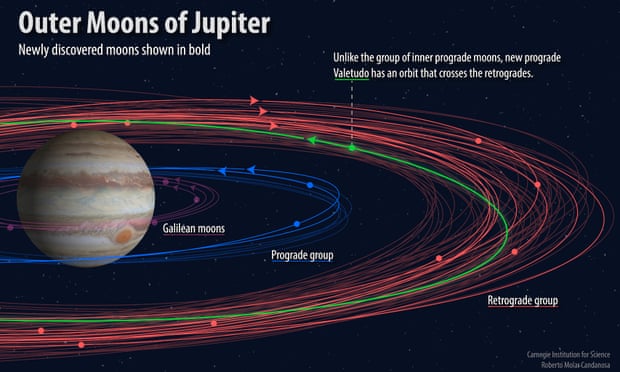
Astronomers have discovered twelve new moons orbiting Jupiter, bringing the total number of Jovian moons to 79.

Nine of the new moons belong to an outer group that orbit Jupiter in retrograde, meaning they travel in the opposite direction to the planet’s spin. They are thought to be the remnants of larger parent bodies that were broken apart in collisions with asteroids, comets and other moons. Each takes about two years to circle the planet.

Two more of the moons are in a group that circle much closer to the planet in prograde orbits which travel in the same direction as Jupiter’s spin. Most likely to be pieces of a once larger moon that was broken up in orbit, they take nearly a year to complete a lap around Jupiter. Which direction the moons swing around the planet depends on how they were first captured by Jupiter’s gravitational field.

Astronomers describe the twelfth new Jovian moon as an “oddball”. Less than a kilometre wide, the tiny body circles Jupiter on a prograde orbit but at a distance that means it crosses the path of other moons hurtling towards it. Scientists have named the new moon Valetudo after the Roman god Jupiter’s great-granddaughter, the goddess of health and hygiene. Collisions aren't frequent and this particular one is also unlikely to happen anytime soon. If it does happen, it can definitely be observed from Earth.

The team suspects that Valetudo is the final remnant of a once much larger moon that has been ground to dust by collisions in the past. Which raises the question of how long the tiny moon has left.


Reference - The Guardian

Read more at the Science Pole App

Wednesday, 5 July 2017

Juno shatters scientists' Jupiter theories in just 365 days

LAST JULY 4TH, NASA's Juno spacecraft slowed its record breaking pace just enough to get caught in the pull of Jupiter's gravity. (The timing, according to NASA, was just a very patriotic coincidence.) Either way, Independence Day 2016 was the last time the Juno mission pumped its brakes. In the year since, the 66-foot solar-powered craft has given scientists more and weirder Jupiter data than they ever thought possible.

So, in honor of Juno's first year orbiting the hitherto mysterious gas giant, here's a rundown of the mission's greatest scientific hits so far.

The Design

Without a good spacecraft and mission plan, Juno never would have left orbit. The Lockheed Martin-built spacecraft itself is an engineering marvel: It has traveled further from Earth (1.7 billion miles!) than any solar-powered craft preceding it, and at speeds never before achieved by a man-made object. Juno's engineers also had to protect the craft's delicate instrumentation—which does everything from snap photos to analyze the gas giant's core—from deep space's pipe-burstingly cold temperatures, not to mention Jupiter's powerful radiation and electric field.

None of which would have been helpful if the mission design didn't allow all that fancy machinery to collect good data. Fortunately for Juno, that hasn't been an issue, even though its flight plan is unconventional in the extreme. Not only are Juno's orbits way, way lower than usual—at their lowest points, just 2,500 miles above Jupiter's famous storm clouds—unlike previous Jupiter missions, they're closely spaced to allow the craft to map the entirety of the planet. "Now that we've had such success, we can say the design is one of our greatest achievements," Scott Bolton, Juno's principal investigator told WIRED in May.

The Poles

The other eccentricity of Juno's orbit is that it isn't equatorial. Instead, it skims over Jupiter's north and south poles, which no one had ever seen before because of Jupiter's very slight axial tilt. (Most planets are tipped over enough for scientists to get a look at their poles from Earth, but Jupiter is practically straight up and down.) Turns out they're stunning—shockingly blue compared to the rest of the planet's stripy orange and white, and covered in cyclones that could swallow Earth whole.

The Atmosphere

So far, Juno has only completed one close pass of Jupiter—what Juno's team calls a science orbit. And while there are still a number of them to go (12 or more, thanks to an engine glitch that actually ended up shielding the spacecraft from additional radiation damage), the results of the first have already challenged long-held scientific theories about gas giants.

Seriously: Jupiter's auroras get energized by pulling electrons out of polar regions (the opposite of how the process works on Earth); and the gas giant's atmosphere, magnetic field, and gravity field are way more mobile and variable than scientific wisdom would have suggested. It's gotten to the point where planetary scientists (including Bolton) wonder if any of their assumptions about gas giants were right.

Which doesn't mean Juno is discouraging scientists. It's the opposite, really. Juno was always meant to rewrite (or at least fill in missing bits of) planetary history. According to theories Juno hasn't yet busted, Jupiter is the planet that started it all in this solar system—its composition is essentially the same as the Sun's, except it's enriched with heavier elements like carbon and nitrogen. So, it's the Sun plus the ingredients for life soup. And while scientists and space fans will have to wait for the next few science orbits to learn what that means, with Juno's track record, whatever answers the spacecraft sends Earthward will likely be field-shaping, and unexpected. So happy first anniversary, Jupiter and Juno. We can't wait to see what science your next year together will bring.

Follow NASA's Juno Mission on Twitter @NASAJuno

Source - www.wired.com