Showing posts with label Chemical Elements - How They Were Discovered. Show all posts

Friday, 4 May 2018

A.1 Iron - Elements Known in Antiquity

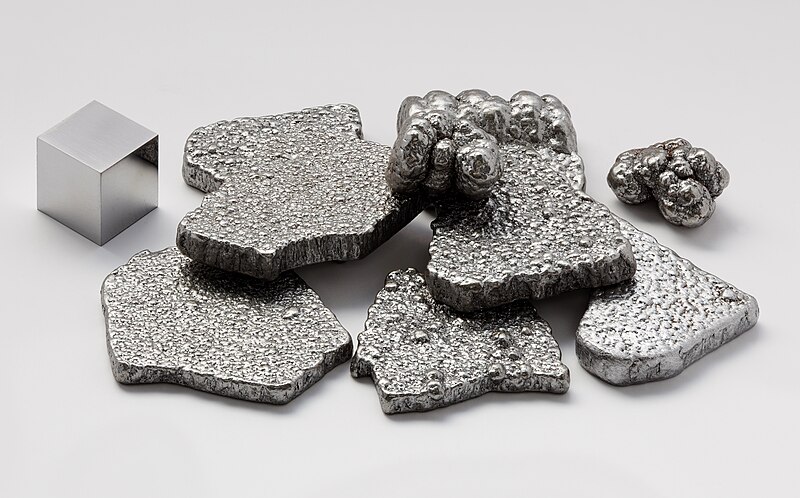
Pure (99.97 %+) iron chips, electrolytically refined and
high purity (99.9999 %) 1 cm3 iron cube

Iron is the second most abundant metal in nature after aluminium. But native iron is extremely rare. Probably, the first iron used by our forefathers was of a meteoritic origin. Iron oxidizes readily in the presence of water and air and is found mainly in the form of oxides. Oxidation of iron is responsible for the fact that extant articles made of iron in antiquity are extremely rare. Man discovered iron about five thousand years ago. At first iron was very expensive and was valued much higher than gold; very often iron jewelry was set in gold.

Peoples of all continents became aware of gold, silver, and copper approximately at the same time; but in the case of iron the situation is different. Thus, in Egypt and Mesopotamia the process of extracting iron from ores was dis-covered two thousand years B.C.; in Trans-Caucasus, Asia Minor, and ancient Greece at the end of the second millennium; in India in the middle of the second millennium; and in China much later, only in the middle of the first millennium B.C. In the countries of the New World Iron Age began only with the arrival of Europeans, i.e. in the second millennium A.D.; some African tribes began to use iron skipping the Bronze Age period in development. This is due to the difference in natural conditions. In countries where natural resources of copper and tin were small, a demand arose for replacing these metals. America had one of the largest deposits of native copper and, therefore, it was not necessary to search for new metals. Gradually, production of iron grew and iron began to pass from the category of precious metals into that of ordinary ones. By the beginning of the Christian era iron was already widely used.

Among all metals and alloys known by that time, iron was the hardest one. Therefore, as soon as iron grew relatively cheap, various tools and weapons were manufactured from it. At the beginning of the first millennium A.D. production of iron in Europe and Asia had made considerable progress; particularly great successes in smelting and processing iron had been achieved by Indian metallurgists.

It is interesting to have a look at the development of iron production methods. At first man used only meteoritic iron, which was very rare and therefore expensive. Then people learnt how to produce iron by intensively heating its ores with coal on windy sites. Iron thus obtained was spongy, of low grade, and with large inclusions of slag. An important step in iron production was made with the invention of a furnace open at the top and lined with a refractory material inside. Excavations of ancient towns in Syria indicate that iron of a rather good quality was produced in this way. Later, people noted that cast iron, which had been considered to be a waste product, could be transformed into iron, the process requiring much less coal and yielding high-quality iron.

Iron meteorites, similar in composition to the Earth's inner- and outer core

By the end of the 15th century first smelting furnaces appeared producing exclusively cast iron. Iron and steel smelting processes were rapidly improving. In 1855 there appeared the converter process of steel making which is still used. The Martin process developed in 1865 yields steel almost free of slags.

A chemical symbol Fe originates from the Latin ferrum, which means "iron".

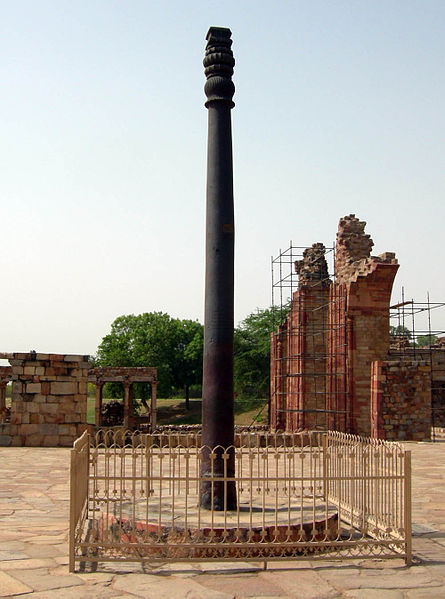
The iron pillar of Delhi is an example of the iron extraction and
processing methodologies of early India


A pot of melted iron in the process of steel-production

Source - Chemical Elements : How They Were Discovered

Read more at the Science Pole App

A.1 Copper - Elements Known in Antiquity

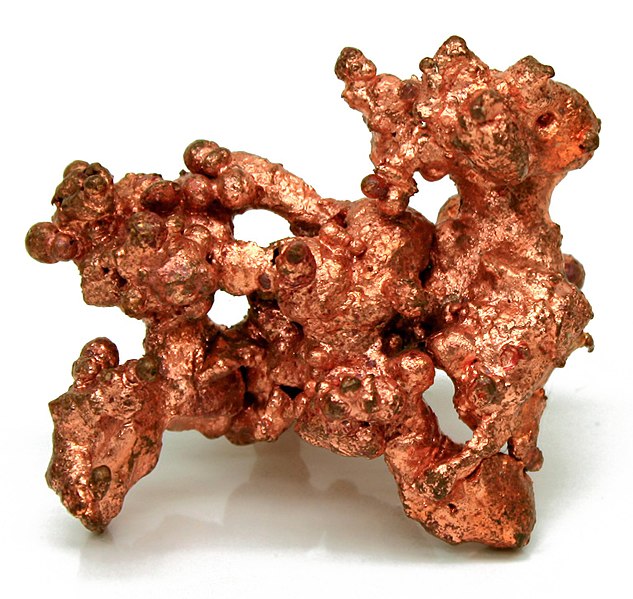
Native copper

According to the French chemist M. Berthelot, mankind came to know copper more than five thousand years ago. Other scientists believe that this acquaintance is much older. Copper and its alloy with tin (bronze) had for a long time been the most widely used metals. These two materials marked a whole epoch in the history of mankind—the Bronze Age. Why did copper play such an important part? Copper is fairly abundant in nature and can readily be worked.

Pierre Eugène Marcellin Berthelot

At first people used only native copper but later rising demand led to the processing of copper ores. It is comparatively simple to smelt the metal from ores with high copper content. As early as the third millennium B.C. copper was widely used for manufacturing various tools. The Egyptian Pyramid of Cheops was built with gigantic stone blocks each of which was hewn with copper tools.

Among the copper mines of antiquity the particularly famous ones were those on the island of Cyprus to which, as has been suggested, copper owes its name (cuprum in Latin).

Only when man had learned to produce bronze, stone tools were completely replaced with bronze ones. Most likely bronze was first obtained by chance. This is evidenced by the archaeological finds on the island of Crete dating back to about 3500 B.C. which revealed not only copper but bronze articles as well. At first bronze was rather expensive and was used mainly for jewelry and luxury articles. In ancient Egypt mirrors were made from bronze. Bronze, like copper, proved to be an excellent material for relict makers and sculptors. As early as the 5th century B.C. man learned to cast bronze statues. Particular progress in bronze sculpture was made in ancient Greece beginning with the Mycenaean period. At our times copper and bronze still retain this role.

Besides bronze, another wonderful copper alloy, brass, has been known for a long time. It was prepared by fusing copper with zinc ore. Ancient Egyptians, Indians, Assyrians, Romans, and Greeks knew copper, bronze, and brass. Both copper and bronze were used for making weapons. In excavations dated back to the 8th-6th centuries B.C. in Altai, Siberia, and Trans-Caucasus archaeologists found knives, arrow-heads, shields, and helmets made from bronze and copper. In ancient Greece and Rome copper and bronze were also used for making shields and helmets. Copper found other uses in firearms when they had been invented.

Source - Chemical Elements : How They Were Discovered

Read more at the Science Pole App

Tuesday, 24 April 2018

A.1 Gold - Elements Known in Antiquity

Karl Marx wrote: "Gold is in fact the first metal that man has discovered".

This is really so. Gold articles were found in excavations together with stone tools dating from the Neolithic Age. But in those times people, evidently, used gold found by chance. Only after the emergence of classes in society first attempts were made to mine gold. The explanation is simple. Gold was particularly suited to play the function of money due to its properties of immutability, easy divisibility, and high cost.

As an ornamental material, gold began to be used from time immemorial. During excavations of pyramids of all dynasties in Egypt archaeologists found in great numbers not only gold jewelry but also household articles.

Gold was known not only in Egypt. As early as in the 10th century B.C. it was used in China, India, states of Mesopotamia. In Greece gold coins circulated as far back as in the 8th-7th centuries B.C. In Armenia gold coins appeared in the 1st century B.C. Thus, gold was known to the peoples of ancient states in Europe and Asia. The oldest gold mines were found in India and Nubia (North-East Africa).

The processes of gold purification known in antiquity did not yield the pure metal but usually alloys consisting of gold and silver which were named azem. A natural gold-silver alloy—electrum—was also known.

No other metal has played so sinister a role as gold in the history of mankind. Wars were waged, nations and states were annihilated, monstrous crimes were committed for the sake of gold. But possession of gold did not bring peace to man. On the contrary, sorrow and fear of losing this treasure filled his soul.

The alchemic period between the 4th and the 16th centuries was a gloomy one in the history of the search for gold. The efforts of alchemists were directed towards the search for the "philosophers' stone" which, they held, possessed the property of transforming base metals into gold. Alchemy did not start from scratch but had important precursors. Egypt's fast rise was due to the fact that Egyptians possessed the secret of gold extraction. It was also known that iron articles that remained in copper mines for a long time became coated with copper. Iron was believed to transform into copper. If it was so, why could not other metals be transformed into gold? Native lead sulphide almost always contains an admixture of silver, which could sometimes be extracted. Could not silver be formed on lead? And, finally, progress in alchemy Was facilitated by the idea about the unity of matter according to which all substances consist of the same components in different ratios.

All the attempts to find the "philosophers' stone" turned out to be unsuccessful (as one should have expected), although many alchemists gave their lives for the idea. All reports about the discoveries of methods of preparing gold from other metals were pure charlatanism.

Alchemy was still flourishing in Europe when the first Spanish conquistadors set out for South and Central America. In the land of Incas they were amazed by the tremendous amounts of gold. For Incas gold was a sacred metal, the Sun God's metal, and colossal amounts of gold had accumulated in the temples. When the Spaniards took Atahualpa, the Great Inca, prisoner, they promised him freedom for a fantastic ransom of almost 50 cu.m. of gold. But Francisco Pizarro thought it dangerous to free the Great Inca and, without waiting for the ransom, the Spaniards executed Atahualpa. When the Incas learned about the death of their leader, the caravan consisting of 1100 llamas carrying gold had already been on its way. Incas hid the gold in the mountains of Azangaro ("the remotest place"). But they could not hide all their treasures. Spaniards captured and looted Cuzco, one of Peru's richest cities. They melted the priceless creations of ancient craftsmen into gold ingots and sent them to Spain.

In Russia mining of gold began in 1600 but it was not until the 19th century that the large scale extraction of this metal started.

The Latin name for gold, aurum, originates from the word Aurora (dawn).

Relative sizes of an 860 kg block of gold ore, and the 30 g of gold that can be extracted from it.

Gold jewelry consumption by country in tonnes


Source - 
Chemical Elements : How They Were Discovered

Read more at the Science Pole App

Wednesday, 18 April 2018

A.1 Sulphur - Elements Known in Antiquity


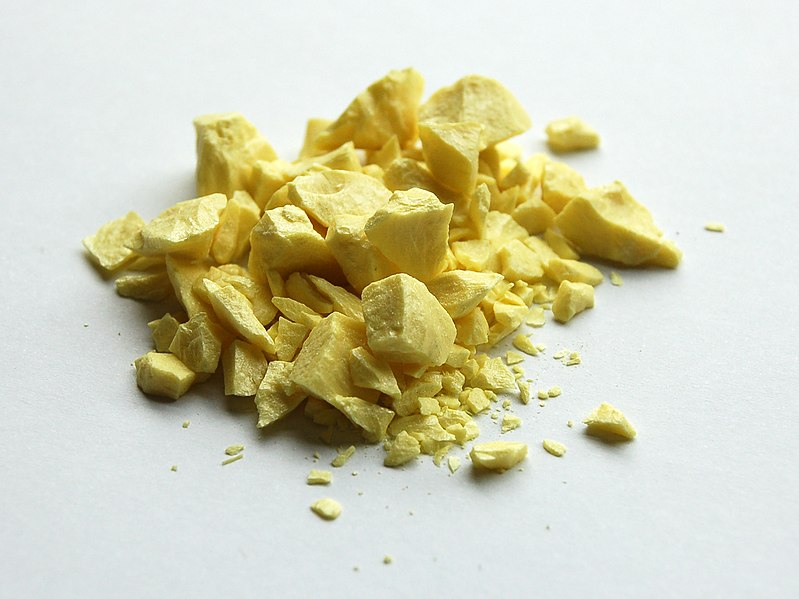
Sulphur has been known to man for a very long time. Even in times of Homer ancient Greeks used the specific properties of sulphur dioxide liberated in the burning of sulphur for disinfection of homes. Deposits of native sulphur have also been known from ancient times. Thus, Pliny the Elder described the deposits of sulphur in Italy and Sicily. Sulphur was used for making dyes and treating fabrics. Like carbon, from the earliest times sulphur was used in pyrotechnics. The composition known by the name of "Greek fire" and invented, apparently, in the 5th century A.D. in Byzantium was a mixture of finely ground sulphur (one part), coal (two parts), and saltpeter (six parts). It is interesting to note that this composition differs only slightly from that of black (smoky) gunpowder.

The fact that sulphur is a good combustible material and combines readily with a great number of metals is responsible for its "privileged" position among other substances in the Middle Ages. Alchemists considered sulphur as the element of combustibility and a constituent of all metals. Very unusual properties were often attributed to sulphur, although some alchemists described its real properties rather accurately.

The elemental nature of sulphur was established by A. Lavoisier. However, in spite of the fact that by the beginning of the 19th century sulphur had already been recognized as an independent element, experiments had to be carried out to elucidate the exact composition of native sulphur. In 1808 H. Davy suggested that sulphur in its usual state is a combination of small amounts of oxygen and hydrogen with a great amount of sulphur. This questioned the elemental nature of sulphur but in 1809 Gay Lussac proved it beyond any doubt. In 1810 H. Davy pointed out that the presence of oxygen in sulphur may be due to sulphur oxides present in native sulphur. The oxygen content in sulphur varied depending on the deposit where the samples were taken. From the standpoint of modern chemistry one may say that oxygen found by Davy in sulphur was not the oxygen of sulphur oxides but that of oxysulphides of various metals, which are always present in sulphur.

The origin of the Latin word "sulphur" is unclear.

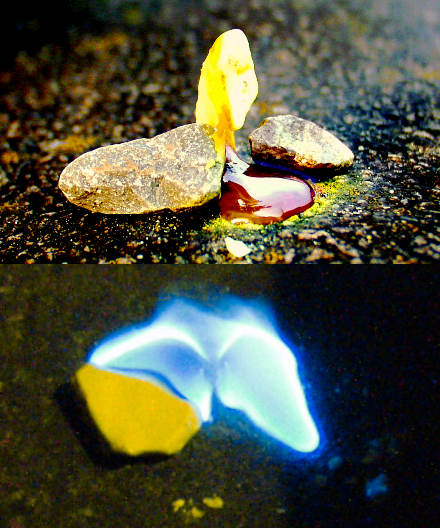
When burned, sulphur melts to a blood-red liquid and emits a blue flame that is best observed in the dark.

Most of the yellow and orange hues of Io (Jupiter's Moon) are due to elemental sulphur and sulphur compounds deposited by active volcanoes.
Source - Chemical Elements : How They Were Discovered

Read more at the Science Pole

A.1 Carbon - Elements Known in Antiquity

The exact date of the discovery of carbon cannot be ascertained. However, it is not difficult to find out when carbon was identified as a simple substance. Let us direct our attention to "The Table of Simple Bodies" compiled by A. Lavoisier and published in 1789. Carbon appears as a simple substance in it. However, the time that carbon needed to occupy its place in the Table is measured not by years and even not by centuries but by millenia. Man had met carbon even before he could make fire—in the form of woods burnt by lightning. After man had learnt how to start a fire, carbon became his constant "companion".

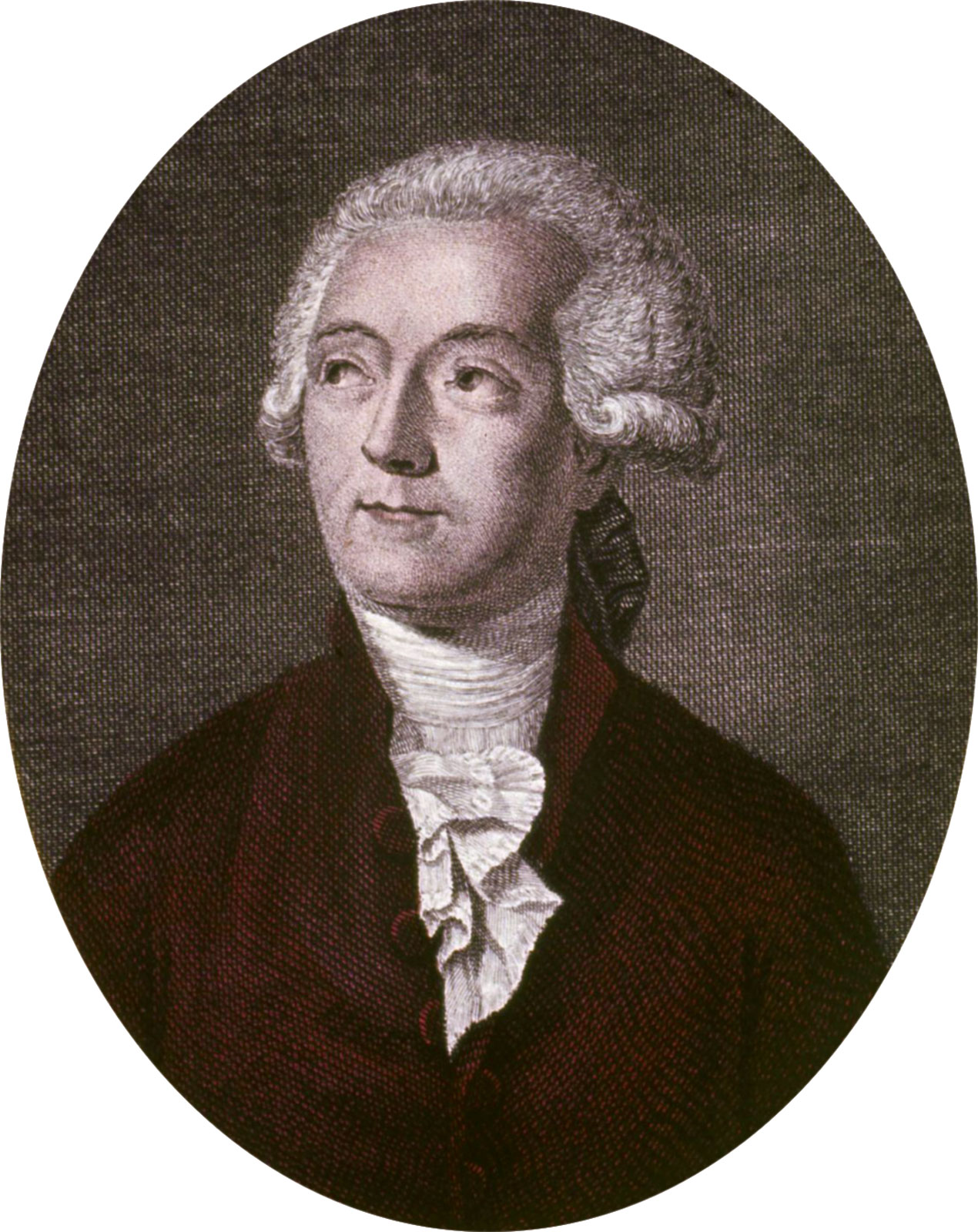
Antoine-Laurent de Lavoisier


Carbon played an important role in the progress of the phlogistic theory. According to this theory carbon was not a simple substance but pure phlogiston. By studying combustion of coal and other compounds, A. Lavoisier was the first to show that carbon is a simple substance. Here we are going to digress a little from the story about how carbon found its identity.

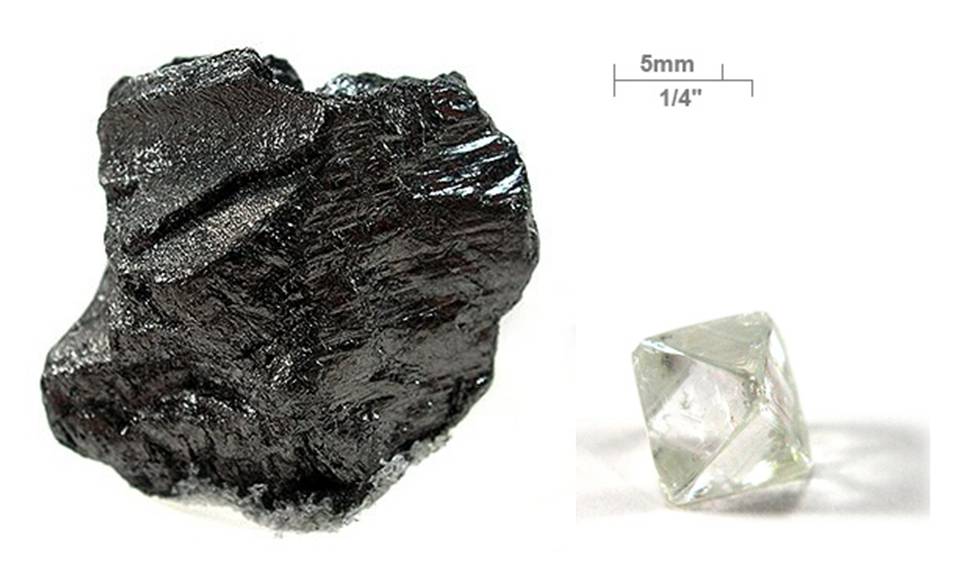
In nature carbon occurs in two allotropic modifications— diamond and graphite, both known to man for a long time. The fact that diamond burns without a residue at very high temperatures was also known long ago. Nevertheless, diamond and graphite were believed to be two quite different substances. The discovery of carbon dioxide was an event which helped to establish that diamond and graphite are modifications of the same substance. After experimenting with the burning of diamond and charcoal, A. Lavoisier established that upon combustion both substances yield carbon dioxide. This prompted the conclusion that diamond and coal have the same origin. The name "carboneum" (carbon) appeared for the first time in the book "Methods of Chemical Nomenclature" (A. Lavoisier, L. Guyton de Morveau, C. Berthollet, and A. Fourcroy) in 1787.

Graphite (left) and diamond (right), two allotropes of carbon

A parallel can be drawn between the element itself, known from time immemorial, and its Latin name whose root originates from Sanscrit, one of the oldest known languages. In Sanscrit "era" means "to boil". The name "carbon" was suggested in 1824.

In 1797 S. Tennant discovered that combustion of equal amounts of diamond and graphite liberates equal amounts of carbon dioxide; in 1799 L. Guyton de Morveau confirmed that carbon is the only constituent of diamond, graphite, and coke. Twenty years later he succeeded in transforming diamond into graphite and then into carbon dioxide by careful heating. But the reverse transformation of graphite into diamond was beyond the power of the science of the 18th and 19th centuries. It was only in 1955 that a group of English scientists obtained artificial diamonds for the first time in the world's history. Synthesis was performed at 3 000°C under a pressure exceeding 109 Pa.

Soon after the synthesis of diamond Soviet scientists prepared a new substance, carbine, which, as has since been proved, is a new, third allotropic modification of carbon. The carbon atoms in it comprise long chains. This, substance resembles soot.

The study of carbon and its compounds laid the foundation of a vast field of chemistry—organic chemistry.

A.1 Elements Known in Antiquity

A.1 Elements Known in Antiquity

Antiquity is, of course, a loose concept and, therefore, this heading under which we discuss several chemical elements is, to a great extent, arbitrary, though it has been widely used in history. This chapter deals with elements (mainly, metals) the use of which is either mentioned in various written sources of the distant past or can be established from the archaeological data.

The use of the term "discovery" is in this case quite arbitrary. Historically speaking, principal characters of this chapter were recognized as independent chemical elements relatively recently. A description of the early history of the elements of antiquity will of necessity have to pass over in silence the dates and the authors of the discoveries. Therefore, the manner of presentation of material in this chapter is rather unusual. It will be a short report on these elements and their application in the distant past.

The chapter is devoted to seven metals of antiquity: gold, silver, copper, iron, tin, lead, and mercury—the "magnificent seven" of metals that played a tremendous role both in the development of civilization and in various schools of natural philosophy. We shall tell you about sulphur, which was widely used long before our time, and about carbon. It may well be that carbon is the oldest chemical element known to mankind. Therefore, we shall begin the history of chemical elements with carbon.

Sometimes zinc, platinum, antimony, and bismuth are also said to be known in antiquity but there is no definite proof of that.

A. Elements Discovered in Nature

Elements Discovered in Nature

Most chemical elements known at present have been discovered in nature (in various ores and minerals, the earth's atmosphere, etc.) and one can say with confidence that there are no more undiscovered elements in nature, including both stable elements and those referred to as naturally radioactive ones. They can be called elements "discovered by means of analysis". They exist independently of man, his knowledge, and methods of investigation. They existed at the earliest stages of evolution of the solar system when the Earth was being formed as a planet.

How these elements were discovered is the subject of the first part of our book.

More than 90 per cent of elements occurring in nature are stable, i.e. not radioactive. They occupy boxes from 1 to 83 in the periodic table, i.e. from hydrogen to bismuth. There are two gaps in this sequence corresponding to the elements with Z = 43 (technetium) and Z = 61 (promethium). The strange properties of atomic nuclei have made all the isotopes of these elements radioactive with relatively short lifetimes; therefore, technetium and promethium have not been preserved in nature but decayed and transformed into the neighbouring stable elements.

The number of naturally radioactive elements on Earth is considerably smaller than that of stable ones. In the periodic table they begin with polonium (Z — 84) and end with uranium (Z = 92). Among them only thorium and uranium have very long half-lives; therefore, they have survived on Earth since the time of its formation and their amounts are rather noticeable. That is why uranium and thorium have been discovered as new chemical elements long before scientists succeeded in observing radioactivity. The amounts of other naturally radioactive elements (polonium, radon, radium, actinium, and protactinium) are much smaller.

0.4 Was There Any Order in the Discoveries of Elements?

Was There Any Order in the Discoveries of Elements?

It would seem more logical to put this question towards the end of the book when the reader is already acquainted with the history of the discovery of each element. All discussions should be supported by the facts and we shall do so in due time. Here we shall give only the general picture, "a bird's-eye view" of the problem so to speak.

Open pages 253-255 of the book where a chronological table of the discoveries of the elements is given. Which of them were discovered in the first place? For about ten of the elements the column "Date of Discovery" contains, instead of an exact date, the words "known in antiquity". The concept of antiquity is rather loose and the words mean only that these elements were known long before our time. Of course, we do not know who discovered them. Archaeologists, whose science is very far removed from chemistry, give more or less reliable information on the time when an element was used by man for the first time in antiquity (without, of course, being perceived as an element). Here is the list of elements known in antiquity: iron, carbon, gold, silver, mercury, tin, copper, lead, sulphur. Even a beginner in chemistry understands that these elements differ broadly in their properties. Why then do they occupy the first place in the list of the discoveries of elements? Is it because they are the most abundant elements on Earth (see the Figure on the end fly-leaf)?

As regards abundance, only iron and carbon are among the ten of the most abundant elements. Sulphur is also fairly abundant. The remaining are rare on Earth.

Topmost in the list of the most abundant elements are oxygen, silicon, and aluminium. Man breathed oxygen unaware that it is a chemical element up to the end of the 18th century. Silicon is the earth's main material but it was discovered only in the 19th century just as aluminium although clay (alumina) had been used for ages.

All this shows that abundance of chemical elements is by no means related to the date of their discovery. Hence, the statement "the more, the earlier" is erroneous. But why were these elements known from time immemorial?

In spite of the difference in their properties, these elements have something in common. Most of them occur in nature not in the form of chemical compounds but as simple substances. For instance, even at present we come across reports of finds of gold nuggets. To find them, no chemical work is required. It is enough just to look for them. Silver and sulphur occur on Earth in a free state (but mainly as constituents of minerals); copper and mercury are encountered in a free state much less frequently. This is why these elements were among the first ones to be discovered by man. A special place is held by carbon; perhaps, it was actually the very first element which announced its existence as ashes of the first camp-fire. Iron gave its name to a whole epoch in the history of mankind—the Iron Age. Many scientists believe that our forebears first began to use iron in a free state, namely the meteorite iron. And only later did the primitive metallurgists learn to smelt iron from iron ore. Tin and lead were smelted from minerals. Extraction of these metals from compounds (the modern term is "the reduction processes") is relatively simple and could be done by people who knew next to nothing about chemical procedures.

In various regions of the globe people began to use this or that element at different times. And, therefore, the most exact discovery date can usually be found from the first mention of an element's use. Obviously here the term "discovery" is arbitrary and has almost nothing in common with its meaning in later time when human knowledge attained a higher level.

The age of discovery of chemical elements began only in the second part of the 18th century. Preceding millenia had seen the discovery of only five new elements: arsenic, antimony, bismuth, phosphorus, and zinc. They were discovered by chance by alchemists who in vain were looking for the philosophers' stone. The peculiar properties of these elements were of great help in their manipulations (such as, for instance, amazing luminescence of phosphorus in the dark and unusual features of arsenic compounds).

The discovery of new chemical elements became a routine matter and not a stroke of good luck only after two main conditions had been met. First of all, chemistry had begun to take shape as an independent science, its experimental methods had become satisfactory, and scientists had learnt how to determine the composition of minerals, those treasure-troves of chemical elements. Secondly, most scientists came at last to a consensus on the conception of a chemical element. It was the beginning of a great analytical period in the development of chemistry in the course of which a large part of naturally-occurring elements were discovered.

Particularly interesting is the story of the discovery of hydrogen and elementary atmospheric gases, nitrogen and oxygen. It became possible owing to the progress in pneumatic chemistry. For a long time the study of gases was the privilege of physicists and for a long time discoverers of new gases believed that they were only varieties of air. The realization that these varieties are chemical elements was slow in coming. It was, first of all, necessary to review cardinally the old theoretical conceptions and to reject the so-called theory of phlogiston, which was believed to be the primary matter of combustion. We shall come back to the phlogiston theory later. These efforts of scientists brought due rewards: the discovery of nitrogen, hydrogen, and oxygen played a gigantic role in advancing the most important concepts of modern chemistry, its theoretical foundations and experimental methods.

Thus it does not seem paradoxical any more that oxygen (the most abundant element constituting almost one half of the earth's crust by mass) was discovered so late. Chemistry had to stand firmly on its feet to be able to identify oxygen as a new simple substance. Adequate methods of investigation were required for this purpose.

Various analytical methods, constantly perfected, were the key factors which led, step by step, to the discovery of new chemical elements. But chemical analysis by itself was not enough to fill all the boxes in the periodic table. The scientists divined the existence of many new elements not because they discovered them, figuratively speaking, on the bottom of a test tube. These elements made their existence in nature known in another way (especially those of them whose abundance is very low).

Billions of years were required for the formation of the earth's crust with its minerals and ores—a process bearing witness to many whims of nature which, to be more exact, reflect the laws of geochemistry. Some elements were less fortunate: they did not succeed in forming their own minerals, that is, those in which they would be the principal or, at least, a noticeable component. They exist only as admixtures to all sorts of minerals consisting of other elements. They seem to be widely dispersed in the earth's crust and are called "trace" elements. Only in the rarest cases do they form their own minerals and if the scientists were lucky to come across them, the new element immediately became the target of chemical analysis. As we shall see later, this was the case of germanium extracted from argyrodite, a uniquely rare mineral.

The other trace elements have quite a different history. Cesium, rubidium, indium, thallium, and gallium are classic examples of new chemical elements which were identified at first without the help of chemistry. They announced themselves with the aid of a peculiar visiting card—their spectrum. It was spectral analysis, a new research method, that contributed to their discovery. If a grain of a substance is introduced into the flame of a gas burner and the light passes through a prism, the refracted light contains a number of differently arranged spectral lines of various colours. Studying the spectra of known elements, scientists came to the conclusion that each element has its own spectral picture. Spectral analysis at once showed itself as a powerful research tool. If the spectrum of a compound contained unknown lines, it was logical to assume that this compound contained a new element. Cesium, rubidium, indium, thallium, and gallium were discovered exactly in this manner. However, in such cases it took courage for scientists to announce the existence of new elements since they had not a grain of them in their hands and did not know their properties.

Such unusual chemical elements as helium, neon, argon, krypton, and xenon were discovered by their spectra. They were termed noble or inert gases. Their content in the atmosphere is extremely low. For a long time these gases were considered to be quite incapable of chemical reactions and some even believed that the name of "a chemical element" was inapplicable to them. Inert elements were discovered without the aid of chemistry but their extraction from the atmosphere and separation from one another became possible only after the development of methods of gas liquefaction at low temperatures.

Naturally, the history of the discovery of chemical elements was to an extent affected by the abundance factor: the elements less abundant in nature were discovered later. The history of natural radioactive elements gives a fine illustration of this idea. They were discovered at the end of the 19th and beginning of the 20th century. And if it had not been for a very important event they would have remained unknown to mankind for a long time since neither chemical nor spectral methods of analysis could detect the negligible concentrations of these elements. The event was the discovery of a new physical phenomenon called radioactivity. Some substances can spontaneously and continuously emit radiation. At first it was established that this property is peculiar not to these substances in general and even not to the constituent chemical compounds but to specific chemical elements, uranium and thorium, placed at the very bottom of the periodic table. In the studies of radioactive substances it was noticed that sometimes their radiation is much stronger than that typical of uranium and thorium atoms. It was suggested that this radiation was due to unknown radioactive elements. The suggestion was confirmed by the discovery of polonium and radium. This led to another research method —the radiometric method—which, in the long run, led to the discovery of other natural radioactive elements. In this example radioactivity served as an identification mark. The radiometric method is incomparably more sensitive than other methods of detection of elements.

A tier the late twenties of our century there were no more discoveries of the elements existing in nature. But this was not the end of history of discoveries of new elements. However, the word "discovery" acquired a new meaning. It now referred to elements not existing on Earth but prepared artificially by means of nuclear reactions. It was a problem of extreme scientific and technical complexity which was tackled by scientists of many countries. All artificial or synthesized elements are radioactive, and therefore, the radiometric method has played a most important role. Here the decisive word was said by physicists. But chemists were confronted with a very difficult problem. Even in our time many synthesized elements can be obtained in the amounts of just a few atoms. When these atoms are highly radioactive their lifetime is only a fraction of a second. Therefore, chemists must show miracles of inventiveness to study their properties.

This, in a nutshell, is the centuries-long process of discovery of the chemical elements, whose symbols now appear in the Mendeleev's Periodic Table. We shall consider this process in detail. Let us now have a closer look at the principal characters of this narrative—one at a time.

But, first, a few words about the structure of the book. It consists of two parts. The first part deals with the natural elements, the second part—with the synthesized ones. It is obvious that the first part must begin with the description of the elements known in antiquity (Chapter 1); then we shall dwell on the elements discovered in the Middle Ages (Chapter 2). The term "discovery" cannot properly be applied to the elements described in these chapters. It acquired the present-day meaning only after the concept of "a chemical element" was made more precise. This was facilitated by the progress in pneumatic chemistry and by a gradual refutation of the phlogistic theory and accompanied by the discovery of oxygen, nitrogen, and hydrogen as well as the understanding of their elementary nature (Chapter 3).

A considerable number of new chemical elements was discovered in the second half of the 18th century and the first half of the 19th century with the aid of the chemical analysis (Chapter 4); the electrochemical method played a certain role in the separation of some alkali and alkaline-earth metals (Chapter 5). At the turn of the fifties of the last century the spectroscopic method was developed, with the help of which it became possible to identify several new elements on Earth (Chapter 6).

Of special interest is the discovery of rare earths, noble (or inert) gases, and, finally, the elements predicted by D. I. Mendeleev on the basis of the periodic system. Although these elements were discovered by means of chemical analysis and spectroscopic method, the histories of the above groups of elements are in many respects highly individual and separate chapters have been devoted to their presentation (Chapters 7, 8; and 9). No less peculiar is the history of the two stable elements which proved to be the last to be discovered on Earth—hafnium and rhenium (Chapter 10). The first part of the book ends with the history of radioactive elements (Chapter 11), which introduces the reader to the world of radioactivity, the world of unstable elements and isotopes the most of which were obtained artificially by means of nuclear reactions.

The second part of the book comprising two chapters (Chapters 12 and 13) is devoted to synthesized elements. In Chapter 12 the reader will be introduced to the synthesis of new elements within the previous boundaries of the periodic system—from hydrogen to uranium (technetium, prome-thium, astatine, francium). Chapter 13 covers the history of transuranium elements and prospects of nuclear synthesis.

The book ends with statistical data on the history of the elements. The concept of "discovery of a chemical element" is discussed again along with false discoveries of chemical elements (the section about false discoveries has been written by V. P. Mel'nikov).
0.3 Introduction - Where did the name "Chemical Element" come from?

Where the Name "Element" Came from
Historians of chemistry have no consensus on this question and only more or less plausible assumptions can be made. The fact is that the concept of "an element" used in ancient times was wider in its meaning than that assigned to a chemical element now. It was to a great extent of a philosophical nature.

One of the hypotheses explaining this is as follows. The word "element" originates from the letters of the Latin alphabet: I, m, n, and t which are pronounced as "el"-"em"-"en"-"te" (in Latin it is "elementum"). Probably, producing the word "element" in this way the scientists wanted to emphasize that as words are composed of letters, different compounds can be represented as constituted by elements. Such interpretation is as simple as it is unexpected. There are other explanations as well but we shall not dwell on them.

How "an Element" Became "a Chemical Element"
Before the modern model of the atom evolved, the concept of an element had been purely speculative. One of the definitions of an element belongs to Aristotle, one of the greatest philosophers of antiquity, who wrote: "Elements are simple substances of which the universe is composed and one of which cannot be separated into the other." Aristotle held that there is one primary matter and four fundamental qualities: heat and coldness, dryness and wetness. Their combinations are material elements: fire, water, air, and earth. According to Aristotle, all bodies are composed of these elements. Aristotle's teaching was the theoretical foundation of alchemy and various natural philosophy schools for many centuries to come.

Only in the 16th century Paracelsus, a famous physician and scientist, brought the elements "closer to the earth". He suggested that all substances consist of three sources, mercury, salt, and sulphur, which are the carriers of three qualities: volatility, solidity, and inflammability.

Hints for a proper understanding of the nature of elements can be found in the teaching of Robert Boyle, an outstanding 17th century English chemist. In his book The Sceptical Chemist Boyle criticized the view of elements as carriers of certain qualities. Elements, according to Boyle, must be material in their nature and constitute solid bodies. Boyle also spoke against the belief that the number of elements is limited, thus opening up possibilities for the discovery of new elements. Nevertheless, it was still a long way to a clear understanding of what a chemical element is and, therefore, scientists could not properly explain the discoveries of new elements.

Antoine Lavoisier's views were a considerable step forward in this field. He clearly stated his conceptions of simple bodies: he believed that all substances which scientists had failed to decompose in any way were elements and he divided all simple substances into four groups.

The first group comprised oxygen, nitrogen, hydrogen, as well as light and "thermogen" (which was, of course, a mistake). A. Lavoisier considered these simple substances to be real elements. Into the second group Lavoisier included sulphur, phosphorus, coal, a radical of muriatic acid (later called chlorine), a radical of hydrofluoric acid (fluorine), and a radical of boric acid (boron). According to Lavoisier, they all were simple non-metallic substances capable of being oxidized and of producing acids. The third group comprised simple metal substances: antimony, silver, arsenic, bismuth, cobalt, copper, tin, iron, manganese, mercury, molybdenum, nickel, gold, platinum, lead, tungsten, and zinc. They also could be oxidized and form acids. And, at last, the fourth group included salt-forming compounds ("earths"), which, however, were known to be complex: lime (calcium oxide), magnesia (magnesium oxide), baryta (barium oxide), alumina (aluminium oxide), and silica (silicon oxide). In 1789 the fact that these substances are oxides of unknown elements was only a conjecture. This classification and comments were still greatly confused and unclear, but, nevertheless, they served as a programme for further research into the nature of elements.

Lavoisier drew no distinction between the concepts of "an element" and "a simple body". They were clearly stated only in the 19th century owing to the development of the atomic and molecular theory and to the work of D. I. Mendeleev.

Monday, 16 April 2018

0.2 Introduction - Concept of a Chemical Element

About eighty years ago Clemens Winkler, the German chemist who discovered germanium which had been predicted by D. Mendeleev under the name of "eka-silicon", likened the world of the elements to the theatre stage where scene after scene is played out with elements, as characters. Each element, Winkler said, plays its own role. Sometimes it is a subsidiary role, sometimes it is a leading role.

In this way the scientist characterized the significance of the elements already discovered and known to man.


Clemens Winkler

Therefore, it is up to us to decide in what sequence the history of the discovery of the elements should be presented.From the standpoint of the history of discovery, there can be neither leading nor subsidiary elements. All elements can lay equal claim to our attention.

We can describe elements in the order of increasing atomic numbers: hydrogen, helium, lithium ... up to element No. 107, which is still unnamed. Or we may describe the history of the discovery of the elements that compose the successive groups of the periodic system. Or we may deal with the elements in an alphabetical order.

We believe that all these ways of presentation are not very successful since they distort the chronology of discoveries. And it is exactly the chronology that we want to make the basis of presentation here.

But at first let us try to understand clearly what is meant by the term "a chemical element".

Concept of a "Chemical Element"

An element is the totality of atoms of a certain type. An atom consists of a nucleus and electrons surrounding it. A nucleus has an integral positive charge denoted by the Latin letter Z. The charge, in its turn, is determined by the number of elementary particles (protons) contained in the nucleus. The charge of the proton (positive) is equal in magnitude to that of the electron (negative). This means that the number of protons (Z) in the nucleus determines the number of electrons in electron shells of the atom. The chemical properties and behaviour of the elements depend on how the electrons are distributed in the shells. Consequently, the nuclear charge Z determines the properties of the chemical element. In addition, Z coincides with the atomic number of the element in the periodic table. For instance, the nucleus of the oxygen atom (atomic number 8) has a positive charge equal to 8, i.e. it contains 8 protons.

Thus, an element is a set of atoms with the same nuclear charge Z which determines the position of the element in the periodic system.

Can atoms of the same element differ from one another? The answer proves to be "yes". In addition to protons, a nucleus contains neutrons. As regards their mass, neutrons differ only slightly from protons, but, in contrast to protons, they carry no charge: they are neutral. There are no nuclei without neutrons (the only exception is the nucleus of the lightest element, hydrogen, which is just a single proton; however, there are different types of hydrogen atoms whose nuclei contain neutrons as well). The total mass of protons and neutrons in a nucleus determines the mass of the atom since the masses of electrons are negligibly small (an electron is 1840 times lighter than a proton). The varieties of the atoms of this or that element whose nuclei contain a different number of neutrons are called isotopic atoms or isotopes. The word "isotope" originates from the Greek isos, "the same", and topos, "place". This means that all the isotopes of the same element occupy the same position in the periodic table. About three-fourths of the naturally occurring elements have isotopes or, as is said, represent a pleiad of isotopes. The remaining elements have no isotopes, i.e. they exist only in one variety of atoms.

Even though the concept of "a chemical element" seems to be quite definite, in reality it is a rather abstract term denoting only a group of atoms with a given nuclear charge. In practice we deal with elements either as constituents of various chemical compounds or as simple substances. A simple substance is a free form of an element which makes it possible to see what the element looks like. Some elements occur in nature only as simple substances, others—as simple substances or as constituents of compounds, and still others exclusively in combinations with other elements. The representatives of the last group are especially numerous. The forms of existence of elements in nature played an important role in the history of their discovery.

Read more at the Science Pole

0.1 Chemical Elements - How They Were Discovered

The following is a series of articles borrowed from "Chemical Elements : How They Were Discovered" an amazing book on the history of the discovery of elements published by MIR in 1982. Several more elements were discovered after the book was published. Nearly 40 years later, this book continues to be one of the best books on the history of elements (with a tinge of bias towards Soviet science).


Chemical Elements - How They Were Discovered


Notice to the Reader


The language of chemistry has its own alphabet. Its letters are symbols of chemical elements; the number of combinations of letters, words composed of them, is infinite — the endless variety of chemical compounds. More than four million chemical compounds are known at present and this number increases each week by six thousand. Apparently, this "word-building" in chemistry is a non-stop process.

Individual letters or elements are much fewer in number: today there are only one hundred and seven of them. Several thousand years were required to compile the alphabet of the language of chemistry but most of the letters were deciphered only during the last two hundred years. It was during this short span of time that chemistry emerged as a science.

All chemical compounds that constitute living and inorganic matter are diverse combinations of eighty-odd elements. The remaining known elements are practically not found in nature. Scientists created them artificially by means of nuclear reactions. More new elements can be obtained in this manner and we do not know how many of them. But it is quite clear that the chemical alphabet is not complete yet.

In this book we shall describe how the alphabet of chemistry has been designed and how the inquisitive mind of the researchers discovered new chemical elements, one after another.

Books have been written about practically all chemical elements—enough to stock a great library. They describe minerals and ores containing chemical elements, processes of their extraction, physical and chemical properties of the elements, and their uses. Many elements are surprisingly abundant.: they can be used in the widely disparate and unexpected fields for the good of mankind. Almost every element has an important role to play in today's advanced science and technology.

The history of chemical elements begins with their discovery. Although hefty volumes in which elements are described in detail pay very little attention to their discoveries, they are a major part of the history of human knowledge.

Each element has its own "biography", interesting in its own way. The history of the discovery of many elements has not yet been exhaustively studied and quite a number of unclear issues should be cleared by historians of chemistry. Perhaps you will be one of them...

Read more at the Science Pole