Showing posts with label Parker Solar Probe Mission. Show all posts

Monday, 10 June 2019

Eugene Parker - the astrophysicist’s discoveries about the Sun led NASA to name a new solar mission after him

Born on 10 June 1927 in Houghton, Michigan, Eugene Parker is an astrophysicist who predicted the existence of the solar wind. Parker received a BS in physics from Michigan State University in 1948 and a PhD from Caltech in 1951. He then taught at the University of Utah, until accepting a position at the University of Chicago in 1955.


Parker began his investigation into the possibility of a solar wind because of the observations of comets and their tails, which always pointed away from the Sun. His mathematical calculations led to his proposing that a stream of high-energy charged particles originates in the Sun’s upper atmosphere and flows at supersonic speeds throughout the solar system and beyond.

The paper he submitted to the Astrophysical Journal was initially rejected. Parker appealed to the journal’s editor, Subrahmanyan Chandrasekhar, who overruled the reviewers and published the paper in 1958. Parker’s theory was validated four years later by measurements taken by the Mariner 2 probe on its way to Venus.

Sixty years later, NASA launched the Parker Solar Probe, the first NASA spacecraft to be named for a living person. Over his career, Parker studied other phenomena, such as cosmic rays and the magnetic fields of galaxies.


Such terms as the Parker instability, the Parker equation, and the Parker limit attest to his contributions to the field. In recognition of his work, he received numerous awards and honours, including the 1978 George Ellery Hale Prize, the 1989 National Medal of Science, the 1992 Royal Astronomical Society Gold Medal, the 1997 Bruce Medal, the 2003 Kyoto Prize, and the 2003 James Clerk Maxwell Prize.

Source - Physics Today

Saturday, 10 March 2018

Send your name to the sun


NASA’s Parker Solar Probe mission – scheduled to launch in summer 2018 – will travel through the sun’s atmosphere and get closer to the solar surface than any spacecraft before it. You can send your name along for the ride.

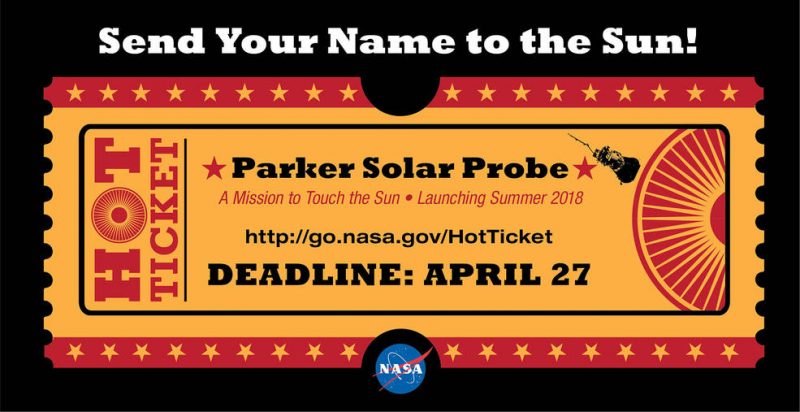
To commemorate humanity’s first visit to our own star, NASA is inviting people around the world to submit their names online to be placed on a microchip aboard the Parker Solar Probe. Submissions will be accepted until April 27, 2018. Learn more and add your name to the mission here. Link to register your name

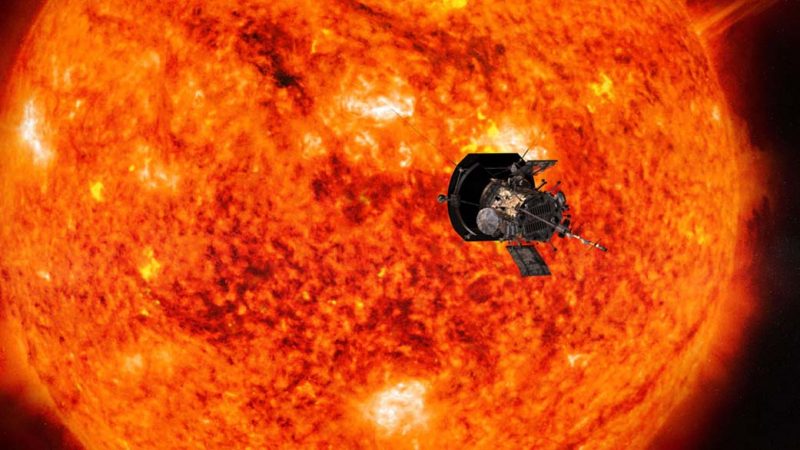
Illustration of the Parker Solar Probe spacecraft approaching the sun

The spacecraft, about the size of a small car, will travel directly into the sun’s atmosphere about 4 million miles (6.4 million km) from its surface. The primary science goals for the mission, said NASA, are to trace how energy and heat move through the solar corona and to explore what accelerates the solar wind as well as solar energetic particles.

The spacecraft speed is so fast, at its closest approach it will be going at approximately 430,000 miles (692,000 km) per hour. That’s fast enough to get from Washington, D.C., to Tokyo in under a minute.

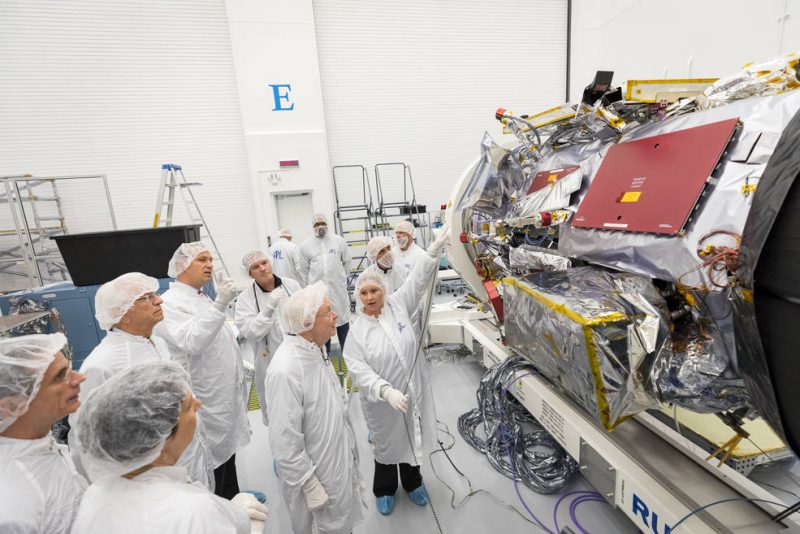
NASA named the spacecraft the Parker Solar Probe in honor of astrophysicist Eugene Parker. This was the first time NASA named a spacecraft for a living individual. In this photo, Eugene Parker, professor emeritus at the University of Chicago, visits the spacecraft that bears his name on October 3, 2017. Engineers in the clean room at the Johns Hopkins Applied Physics Laboratory in Laurel, Maryland, where the probe was designed and built, point out the instruments that will collect data as the mission travels directly through the sun’s atmosphere.

To perform its investigations, the spacecraft and instruments will be protected from the sun’s heat by a 4.5-inch-thick (11.4 cm) carbon-composite shield, which will need to withstand temperatures outside the spacecraft that reach nearly 2,500 degrees Fahrenheit (1,371 degrees C). This heat shield will keep the four instrument suites designed to study magnetic fields, plasma and energetic particles, and image the solar wind, at room temperature.

Send your name to the sun, via a microchip installed on NASA’s upcoming Parker Solar Probe mission. Submissions will be accepted until April 27, 2018.


Sources -
  1. NASA
  2. EarthSky.org