Saturday, 10 March 2018

Send your name to the sun


NASA’s Parker Solar Probe mission – scheduled to launch in summer 2018 – will travel through the sun’s atmosphere and get closer to the solar surface than any spacecraft before it. You can send your name along for the ride.

To commemorate humanity’s first visit to our own star, NASA is inviting people around the world to submit their names online to be placed on a microchip aboard the Parker Solar Probe. Submissions will be accepted until April 27, 2018. Learn more and add your name to the mission here. Link to register your name
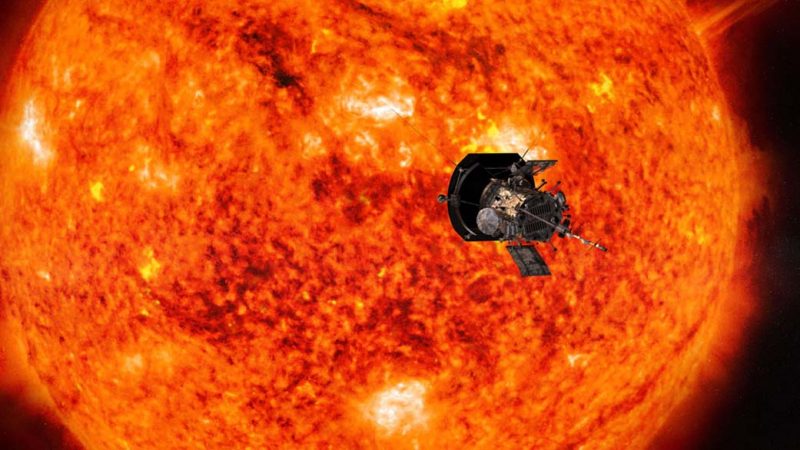
Illustration of the Parker Solar Probe spacecraft approaching the sun

The spacecraft, about the size of a small car, will travel directly into the sun’s atmosphere about 4 million miles (6.4 million km) from its surface. The primary science goals for the mission, said NASA, are to trace how energy and heat move through the solar corona and to explore what accelerates the solar wind as well as solar energetic particles.

The spacecraft speed is so fast, at its closest approach it will be going at approximately 430,000 miles (692,000 km) per hour. That’s fast enough to get from Washington, D.C., to Tokyo in under a minute.
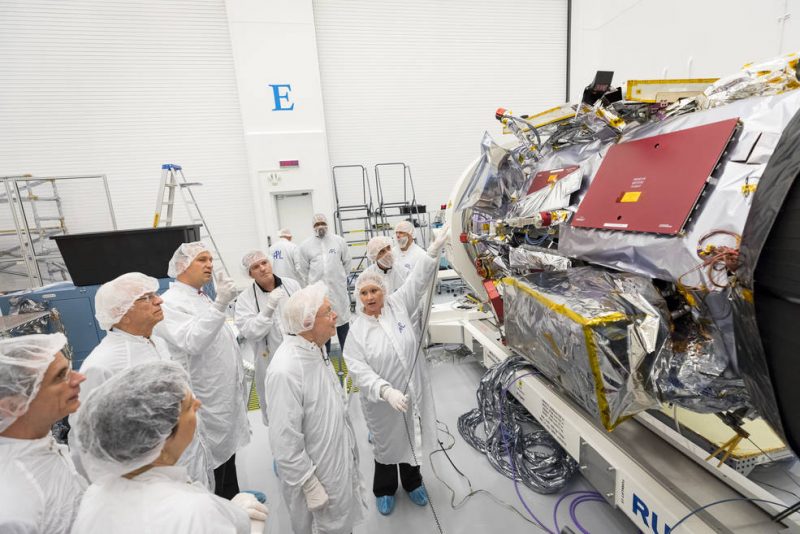
NASA named the spacecraft the Parker Solar Probe in honor of astrophysicist Eugene Parker. This was the first time NASA named a spacecraft for a living individual. In this photo, Eugene Parker, professor emeritus at the University of Chicago, visits the spacecraft that bears his name on October 3, 2017. Engineers in the clean room at the Johns Hopkins Applied Physics Laboratory in Laurel, Maryland, where the probe was designed and built, point out the instruments that will collect data as the mission travels directly through the sun’s atmosphere.

To perform its investigations, the spacecraft and instruments will be protected from the sun’s heat by a 4.5-inch-thick (11.4 cm) carbon-composite shield, which will need to withstand temperatures outside the spacecraft that reach nearly 2,500 degrees Fahrenheit (1,371 degrees C). This heat shield will keep the four instrument suites designed to study magnetic fields, plasma and energetic particles, and image the solar wind, at room temperature.
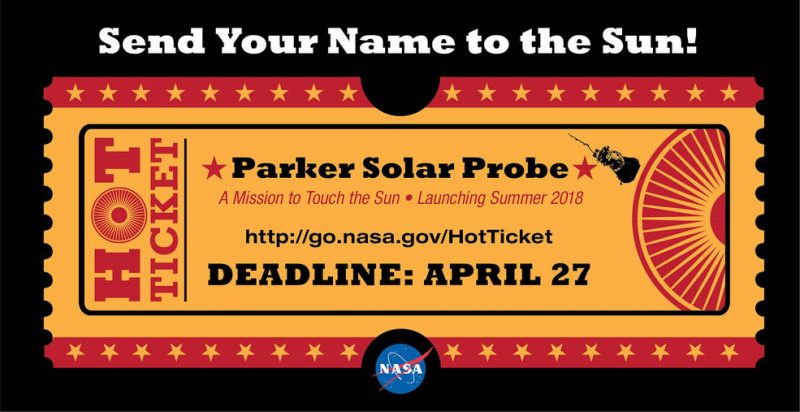
Send your name to the sun, via a microchip installed on NASA’s upcoming Parker Solar Probe mission. Submissions will be accepted until April 27, 2018.


Sources -
  1. NASA
  2. EarthSky.org

Wednesday, 7 March 2018

China's Tiangong-1 space station will crash to Earth within weeks

The Tiangong-1 space station, which is expected to come crashing to earth within weeks

China’s first space station is expected to come crashing down to Earth within weeks, but scientists have not been able to predict where the 8.5-tonne module will hit.

The US-funded Aerospace Corporation estimates Tiangong-1 will re-enter the atmosphere during the first week of April, give or take a week. The European Space Agency says the module will come down between 24 March and 19 April.

In 2016 China admitted it had lost control of Tiangong-1 and would be unable to perform a controlled re-entry.

Aerospace Corporation said there was “a chance that a small amount of debris” from the module will survive re-entry and hit the Earth. If this should happen, any surviving debris would fall within a region that is a few hundred kilometers in size. Aerospace Corporation also warned that the space station might be carrying a highly toxic and corrosive fuel called hydrazine on board.

The module is expected to re-enter somewhere between 43° north and 43° south latitudes. The chances of re-entry are slightly higher in northern China, the Middle East, central Italy, northern Spain and the northern states of the US, New Zealand, Tasmania, parts of South America and southern Africa. However, the chance of debris hitting anyone living in these nations is tiny.

In the history of spaceflight no known person has ever been harmed by reentering space debris. Only one person has ever been recorded as being hit by a piece of space debris and, fortunately, she was not injured.

Tiangong-1’s descent had been speeding up in recent months and it was now falling by about 6km a week, compared with 1.5km in October. It was difficult to predict when the module might land because its speed was affected by the constantly changing “weather” in space.

A chart showing the descent of the Tiangong-1

The Tiangong-1 or Heavenly Palace lab was launched in 2011 and described as a potent political symbol of China – part of a scientific push to become a space superpower. It was used for both manned and unmanned missions and visited by China’s first female astronaut, Liu Yang, in 2012.

Liu Yang, a Chinese pilot and astronaut who served as a crew member on the space mission Shenzhou 9. On 16 June 2012, Liu became the first Chinese woman in space.

In 1991 the Soviet Union’s 20-tonne Salyut 7 space station crashed to Earth while still docked to another 20-tonne spacecraft called Cosmos 1686. They broke up over Argentina, scattering debris over the town of Capitán Bermúdez.

Soviet orbital station Salyut 7

Nasa’s 77-tonne Skylab space station came hurtling to Earth in an almost completely uncontrolled descent in 1979, with some large pieces landing outside Perth in Western Australia.

Skylab Orbital Workshop in Earth orbit 


Fragment of Skylab recovered after its re-entry through Earth's atmosphere

Sources -
  1. The Guardian - Science
  2. Wikipedia