March 17, 1962 – birthday of Kalpana Chawla, an Indian American astronaut and the first woman of Indian origin in space. Kalpana Chawla was born in Karnal, Punjab (now in Haryana). Her official date of birth was altered to 1 July 1961 to allow her to join school underage.

After getting a Bachelor of Science degree in Aeronautical Engineering from Punjab Engineering College, Chandigarh, she moved to USA in 1982 where she obtained the Master of Science degree in Aerospace Engineering from the University of Texas in 1984.
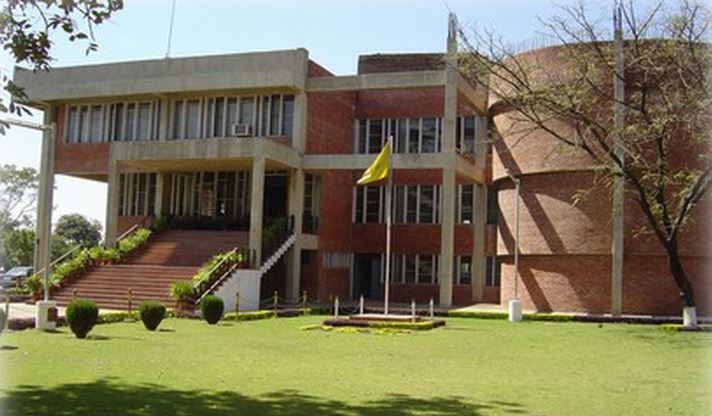 |
| Punjab Engineering College |
Chawla went on to earn a second Masters in 1986 and a PhD in aerospace engineering in 1988 from the University of Colorado, Boulder. She held a Certificated Flight Instructor rating for airplanes, gliders and Commercial Pilot licenses for single and multi-engine airplanes, seaplanes and gliders.
 |
| Logo of University of Colorado Boulder. |
After becoming a naturalized US citizen in April 1991, Chawla applied for the NASA Astronaut Corps. She joined the Corps in March 1995 and was selected for her first flight in 1996. Her first space mission began on November 19, 1997, as part of the crew that flew the Space Shuttle Columbia flight STS-87.
 |
| Columbia launches on STS-87 |
 |
| The STS-87 patch is shaped like a space helmet symbolizing the Extravehicular Activity (EVA) on the mission in support of testing of tools for the assembly of the International Space Station (ISS). Earth is shown reflected on the backside of the helmet. The Space Shuttle Columbia forms the interface between the Earth and the heavens, the back and front sides of the helmet in profile. The three red lines emerging from Columbia represent the astronaut symbol as well as the robot arm, which was used to deploy and retrieve the Spartan satellite. The text 'µg' represents the payloads studying microgravity science in space on this United States Microgravity Payload (USMP-4) mission. Gold flames outlining the helmet visor represent the corona of the Sun, which will be studied by Spartan. The flag of Ukraine is next to the name of the payload specialist who is the first person from that nation to fly on the Space Shuttle. |
Chawla was the first Indian-born woman and the second Indian person to fly in space, following cosmonaut Rakesh Sharma who flew in 1984 on the Soyuz T-11.
In 2000, Chawla was selected for her second flight as part of the crew of STS-107. This mission was repeatedly delayed due to scheduling conflicts and technical problems such as the discovery of cracks in the shuttle engine flow liners. On January 16, 2003, Chawla finally returned to space aboard Space Shuttle Columbia on the ill-fated STS-107 mission. Chawla's responsibilities included the microgravity experiments, for which the crew conducted nearly 80 experiments studying earth and space science, advanced technology development, and astronaut health and safety.
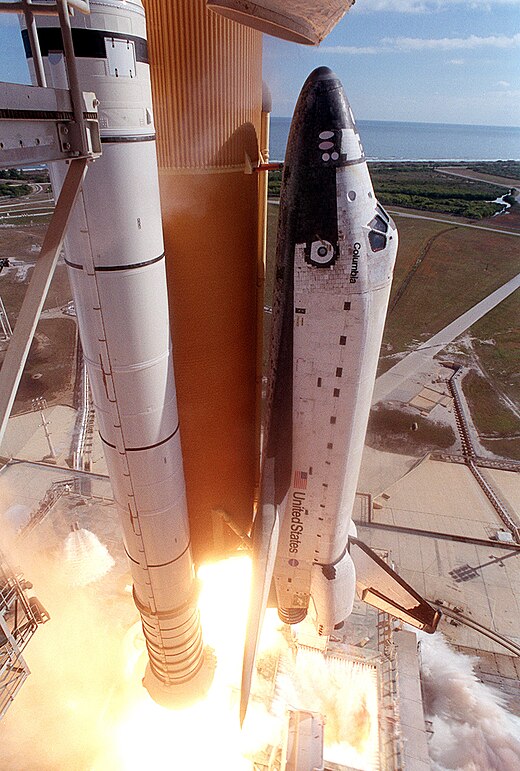 |
| Space Shuttle Columbia lifts off from Launch Pad 39A on mission STS-107. Launch occurred on 16th January, 2003 |
 |
| Insignia for STS-107 - a multi-discipline microgravity and Earth science research mission with a multitude of international scientific investigations conducted continuously during the planned 16 days on orbit. The central element of the patch is the microgravity symbol, µg, flowing into the rays of the astronaut symbol. The mission inclination is portrayed by the 39 degree angle of the astronaut symbol to the Earth's horizon. The sunrise is representative of the numerous experiments that are the dawn of a new era for continued microgravity research on the International Space Station and beyond. The breadth of science conducted on this mission will have widespread benefits to life on Earth and our continued exploration of space illustrated by the Earth and stars. The constellation Columbia (the dove) was chosen to symbolize peace on Earth and the Space Shuttle Columbia. The seven stars also represent the mission crew members and honor the original astronauts who paved the way to make research in space possible. The Israeli flag is adjacent to the name of the payload specialist who is the first person from that country to fly on the Space Shuttle. |
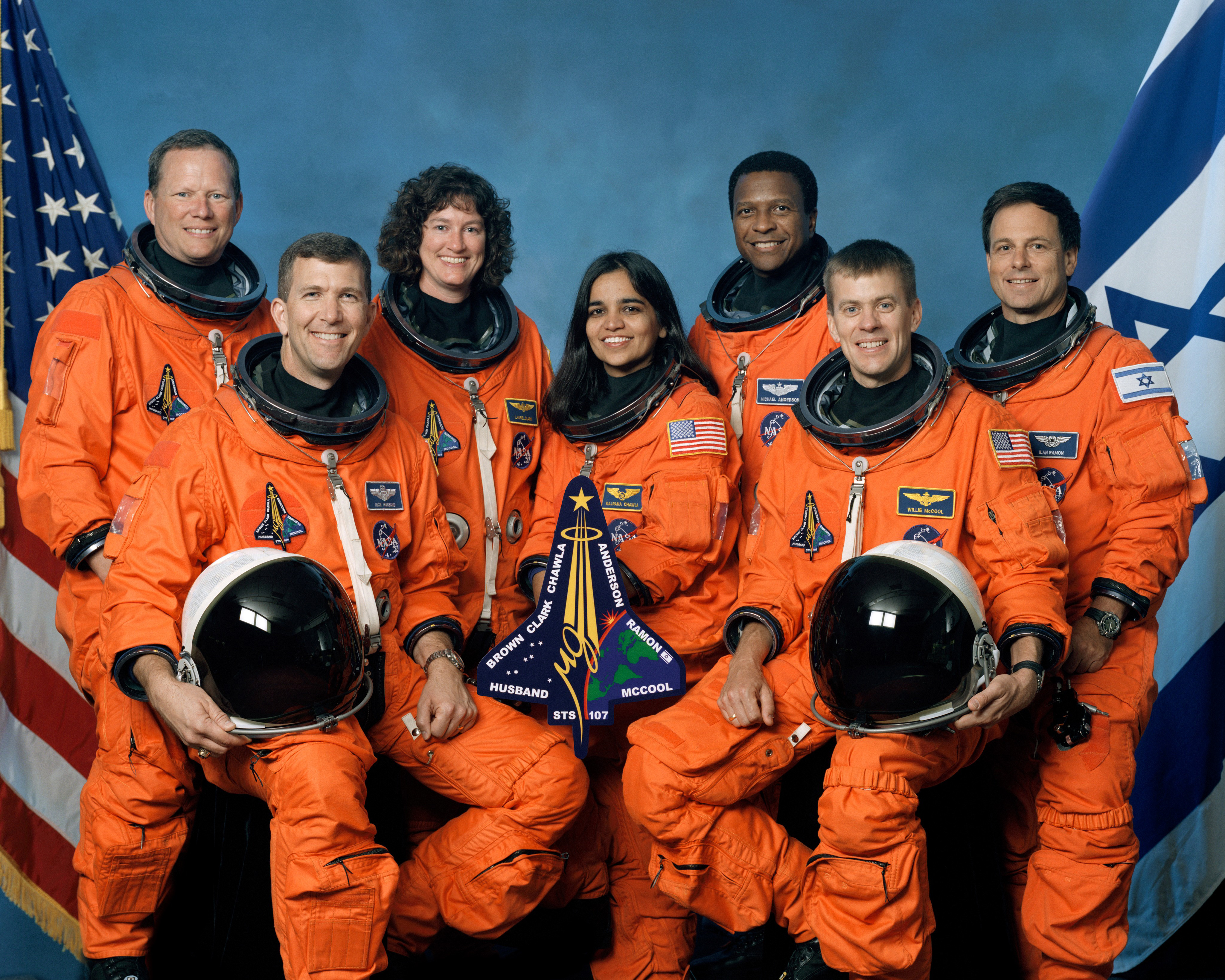 |
| The crew of the Space Shuttle Columbia, mission STS-107. From left to right are mission specialist David Brown, commander Rick Husband, mission specialist Laurel Clark, mission specialist Kalpana Chawla, mission specialist Michael Anderson, pilot William McCool, and Israeli payload specialist Ilan Ramon. |
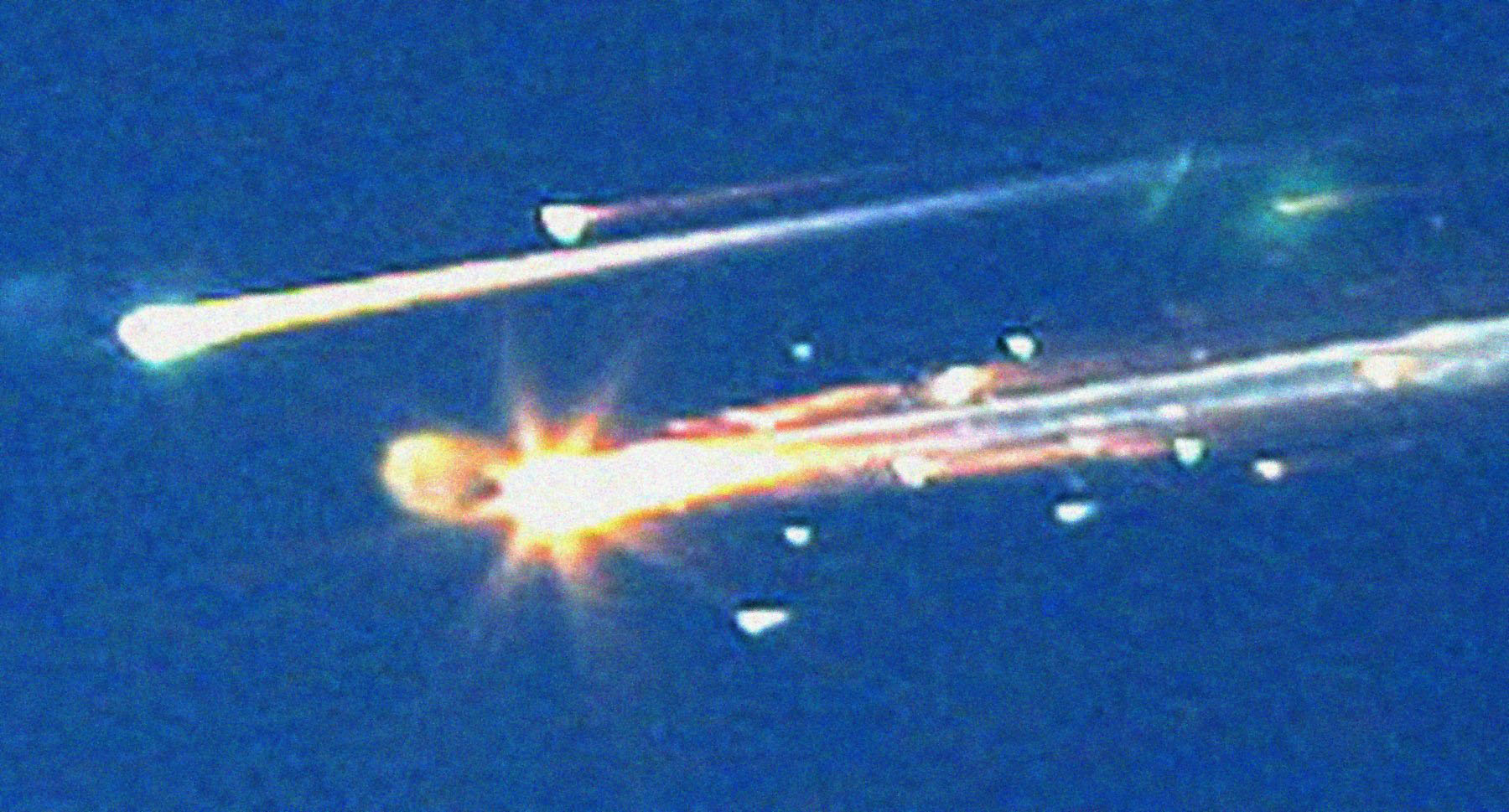
During the launch of STS-107, Columbia's 28th mission, a piece of foam insulation broke off from the Space Shuttle external tank and struck the left wing of the orbiter. It was suspected that the damage to Columbia was more serious than in the previous shuttle launches but the investigation was limited with the reasoning that the crew could not have fixed the problem if it had been confirmed. When
Columbia re-entered the atmosphere of Earth, the damage allowed hot atmospheric
gases to penetrate and destroy the internal wing structure, which caused the
spacecraft to become unstable and slowly break apart.
 |
| One of the Space Shuttle Columbia's Main Engine powerheads found on the ground |
 |
| The Final Report of the Columbia Accident Investigation - download the info-graphic here |
Primary Source - Wikipedia


