March 20, 1916 - Albert Einstein's Theory of General Relativity was published as an academic paper in Annalen der Physik.
Einstein's Theory of General Relativity
In 1905, Albert Einstein determined that the laws of physics are the same for all non-accelerating observers, and that the speed of light in a vacuum was independent of the motion of all observers. This was the theory of special relativity. It introduced a new framework for all of physics and proposed new concepts of space and time.
Einstein then spent 10 years trying to include acceleration in the theory and published his theory of general relativity in 1915. In it, he determined that massive objects cause a distortion in space-time, which is felt as gravity.
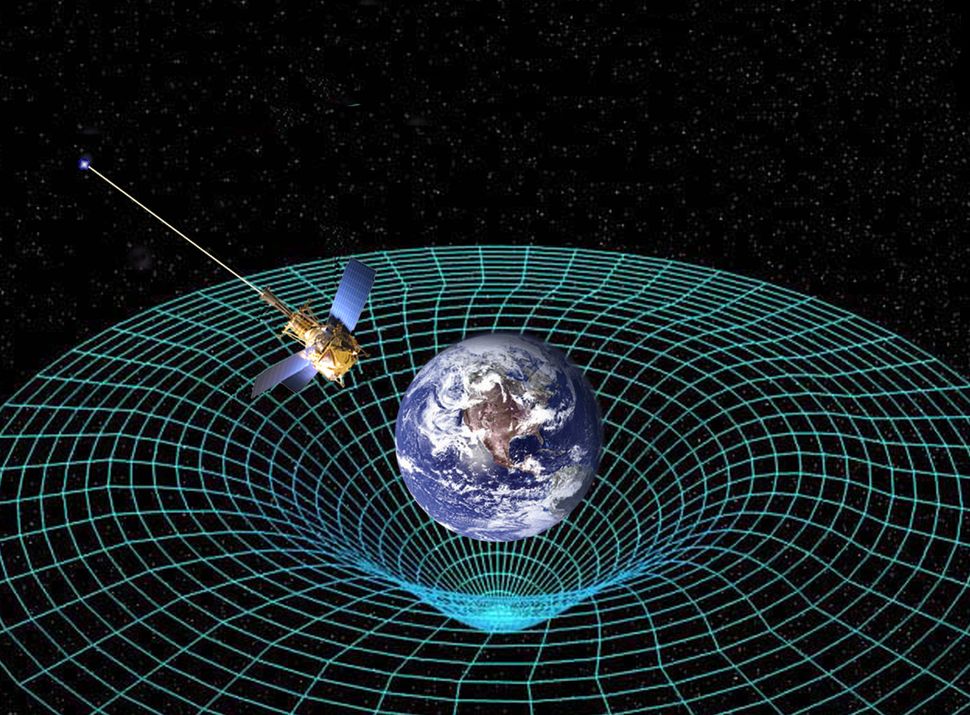 |
| Einstein's theory of general relativity predicted that the space-time around Earth would be not only warped but also twisted by the planet's rotation. Gravity Probe B showed this to be correct. |
Gravity
Two objects exert a force of attraction on one another known as "gravity." Sir Isaac Newton quantified the gravity between two objects when he formulated his three laws of motion. The force tugging between two bodies depends on how massive each one is and how far apart the two lie. Even as the center of the Earth is pulling you toward it (keeping you firmly lodged on the ground), your center of mass is pulling back at the Earth. But the more massive body barely feels the tug from you, while with your much smaller mass you find yourself firmly rooted thanks to that same force. Yet Newton's laws assume that gravity is an innate force of an object that can act over a distance.
Albert Einstein, in his theory of special relativity, determined that the laws of physics are the same for all non-accelerating observers, and he showed that the speed of light within a vacuum is the same no matter the speed at which an observer travels. As a result, he found that space and time were interwoven into a single continuum known as space-time. Events that occur at the same time for one observer could occur at different times for another.
As he worked out the equations for his general theory of relativity, Einstein realized that massive objects caused a distortion in space-time. Imagine setting a large body in the center of a trampoline. The body would press down into the fabric, causing it to dimple. A marble rolled around the edge would spiral inward toward the body, pulled in much the same way that the gravity of a planet pulls at rocks in space.
Experimental evidence
Although instruments can neither see nor measure space-time, several of the phenomena predicted by its warping have been confirmed.
Gravitational lensing - Light around a massive object, such as a black hole, is bent, causing it to act as a lens for the things that lie behind it. Astronomers routinely use this method to study stars and galaxies behind massive objects.
Einstein's Cross, a quasar in the Pegasus constellation, is an excellent example of gravitational lensing. The quasar is about 8 billion light-years from Earth, and sits behind a galaxy that is 400 million light-years away. Four images of the quasar appear around the galaxy because the intense gravity of the galaxy bends the light coming from the quasar.
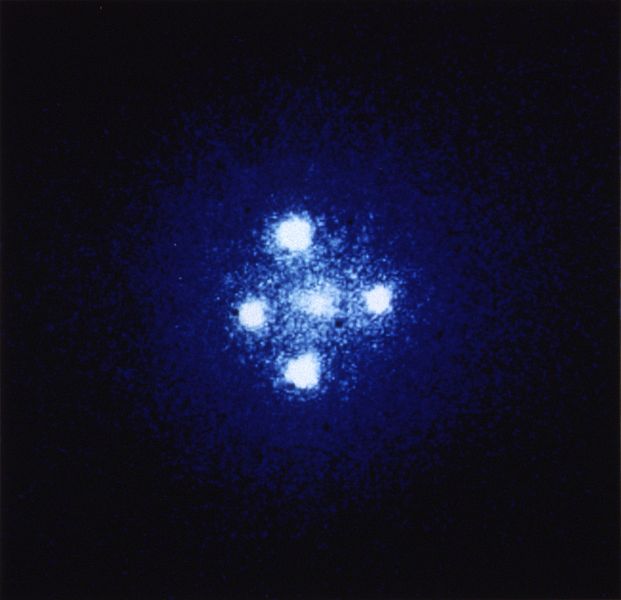 |
| Einstein's Cross is an example of gravitational lensing |
Gravitational lensing can allow scientists to see some pretty cool things, but until recently, what they spotted around the lens has remained fairly static. However, since the light traveling around the lens takes a different path, each traveling over a different amount of time, scientists were able to observe a supernova occur four different times as it was magnified by a massive galaxy.
In another interesting observation, NASA's Kepler telescope spotted a dead star, known as a white dwarf, orbiting a red dwarf in a binary system. Although the white dwarf is more massive, it has a far smaller radius than its companion.
Changes in the orbit of Mercury - The orbit of Mercury is shifting very gradually over time, due to the curvature of space-time around the massive sun. In a few billion years, it could even collide with Earth.
Frame-dragging of space-time around rotating bodies - The spin of a heavy object, such as Earth, should twist and distort the space-time around it. Imagine the Earth as if it were immersed in honey. As the planet rotates, the honey around it would swirl, and it's the same with space and time.
In 2004, NASA launched the Gravity Probe B (GP-B). The precisely calibrated satellite caused the axes of gyroscopes inside to drift very slightly over time, a result that coincided with Einstein's theory. GP-B confirmed two of the most profound predictions of Einstein's universe, having far-reaching implications across astrophysics research.
Gravitational red-shift - The electromagnetic radiation of an object is stretched out slightly inside a gravitational field. Think of the sound waves that emanate from a siren on an emergency vehicle; as the vehicle moves toward an observer, sound waves are compressed, but as it moves away, they are stretched out, or red-shifted. Known as the Doppler Effect, the same phenomena occurs with waves of light at all frequencies.
In 1959, two physicists, Robert Pound and Glen Rebka, shot gamma-rays of radioactive iron up the side of a tower at Harvard University and found them to be minutely less than their natural frequency due to distortions caused by gravity.
Gravitational waves - Violent events, such as the collision of two black holes, are thought to be able to create ripples in space-time known as gravitational waves.
In 2016, the Laser Interferometer Gravitational Wave Observatory (LIGO) announced that it found evidence of these tell-tale indicators. In 2014, scientists announced that they had detected gravitational waves left over from the Big Bang using the Background Imaging of Cosmic Extragalactic Polarization (BICEP2) telescope in Antarctica. It is thought that such waves are embedded in the cosmic microwave background. However, further research revealed that their data was contaminated by dust in the line of sight.
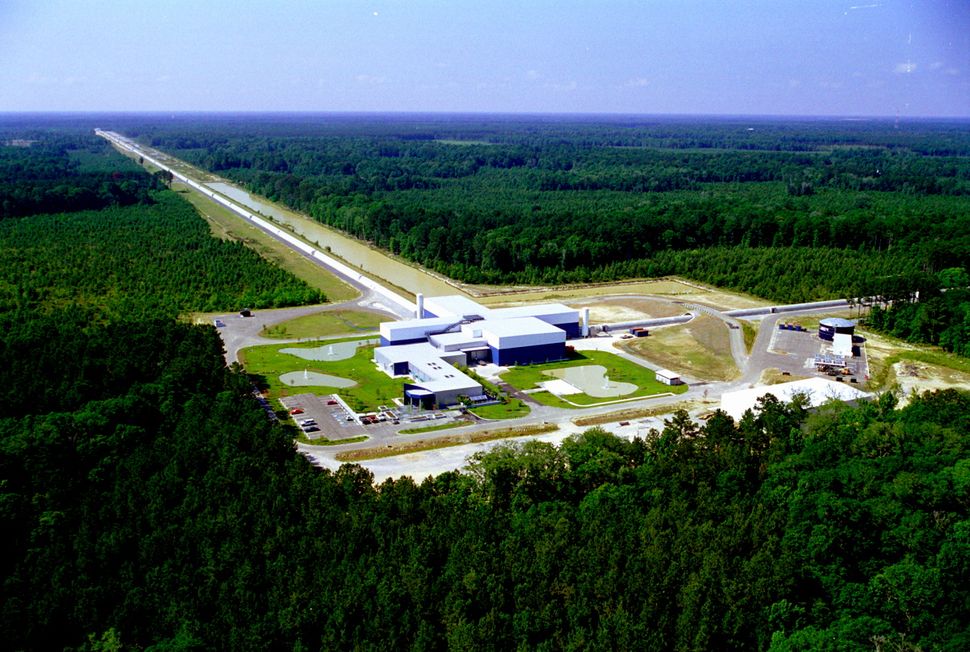 |
| Aerial photo of LIGO Livingston, Louisiana, showing all of one 4 kilometer long arm and part of the other (off to the right). The visible arms are concrete structures that protect the vacuum tubes from the elements. |
India is also going to join the hunt for Gravitational Waves by building a gravitational-wave detector that will work in concert with the two detectors currently operating in the United States and a third detector set to come online in Italy. The project could come online as soon as 2023.
Sources -
1. Space.com
2. Wikipedia
3. Pacific Science Center