
The Latitude is a measurement of distance north or south of the equator, the imaginary line that encircles the middle of the planet. The equator's latitude is 0 degrees, and there are 180 imaginary lines (known as parallels) that circle Earth from east to west that run parallel to the equator. And while there aren't proper names for all of them, there are five major ones to know: the equator, the Tropics of Cancer and Capricorn, and the Arctic and Antarctic circles.
The Tropic of Cancer, which is also referred to as the Northern Tropic, is the most northerly circle of latitude on Earth at which the Sun can be directly overhead. This occurs on the June solstice when the Northern Hemisphere is tilted toward the Sun to its maximum extent. It is currently 23°26′12.1″ (or 23.43668°) north of the Equator.

Its Southern Hemisphere counterpart, marking the most southerly position at which the Sun can be directly overhead, is the Tropic of Capricorn. The positions of these two circles of latitude (relative to the Equator) are dictated by the tilt of Earth's axis of rotation relative to the plane of its orbit, and since the tilt changes, the location of these two circles also changes.
When this line of latitude was named in the last centuries BC, the Sun was in the constellation Cancer (Latin for crab) at the June solstice, the time each year that the Sun reaches its zenith at this latitude. Due to the precession of the equinoxes, this is no longer the case; today the Sun is in Taurus at the June solstice. The word "tropic" itself comes from the Greek "trope", meaning turn (change of direction, or circumstances), inclination, referring to the fact that the Sun appears to "turn back" at the solstices.
There are approximately 13 hours, 35 minutes of daylight during the summer solstice. During the winter solstice, there are 10 hours, 41 minutes of daylight.
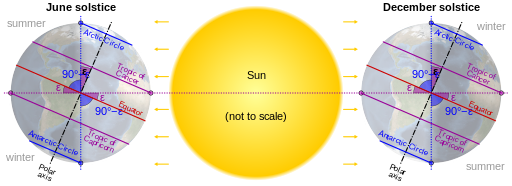
The Tropic of Cancer's position is not fixed but constantly changes because of a slight wobble in the Earth's longitudinal alignment relative to its orbit around the Sun. Earth's axial tilt varies over a 41,000-year period from 22.1 to 24.5 degrees and currently resides at about 23.4 degrees. This wobble means that the Tropic of Cancer is currently drifting southward at a rate of almost half an arcsecond (0.468″) of latitude, or 15 meters, per year (it was at exactly 23°27′N in 1917 and will be at 23°26'N in 2045).
_Zaragoza-Victoria%2C_Km_27%2B800.jpg/1024px-Tr%C3%B3pico_de_C%C3%A1ncer_en_M%C3%A9xico_-_Carretera_83_(V%C3%ADa_Corta)_Zaragoza-Victoria%2C_Km_27%2B800.jpg) |
| At this place where the Mexican Highway crosses the Tropic of Cancer, the latitude is marked with precision and where the annual drift between the years 2005 and 2010 can be appreciated. |
Sources -
- Wikipedia
- HowStuffWorks
- PHP Science Labs


