|
| Neptune - the farthest planet |
The planet Neptune was mathematically predicted before it was directly observed. With a prediction by Urbain Le Verrier, telescopic observations confirming the existence of a major planet were made on the night of September 23–24, 1846, at the Berlin Observatory, by astronomer Johann Gottfried Galle (assisted by Heinrich Louis d'Arrest), working from Le Verrier's calculations. It was a sensational moment of 19th-century science, and dramatic confirmation of Newtonian gravitational theory. In François Arago's apt phrase, Le Verrier had discovered a planet "with the point of his pen".
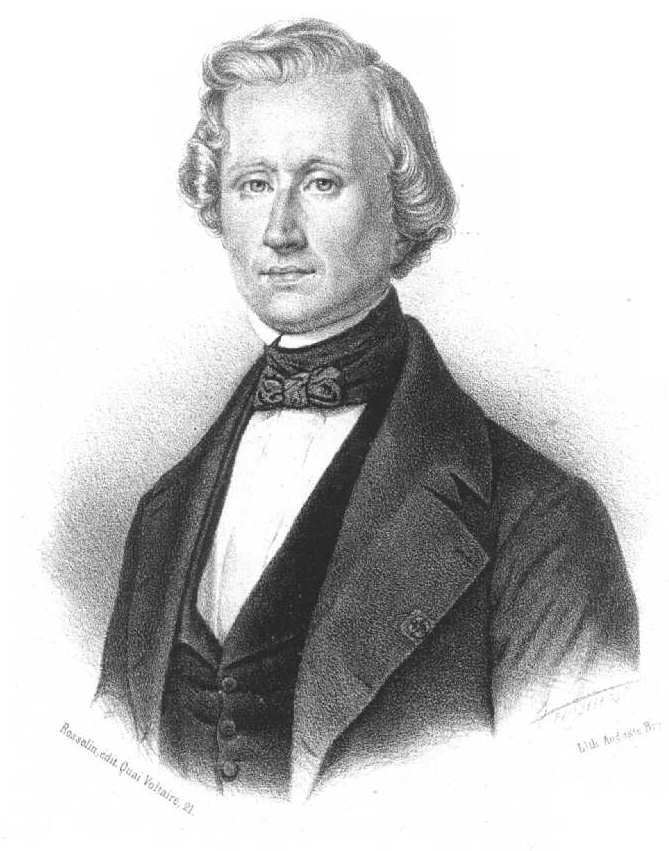 |
| Urbain Le Verrier |
Seen, but not discovered!
In retrospect, after it was discovered, it turned out it had been observed many times before but not recognized, and there were others who made various calculations about its location which did not lead to its observation.
By 1847, the planet Uranus had completed nearly one full orbit since its discovery by William Herschel in 1781, and astronomers had detected a series of irregularities in its path that could not be entirely explained by Newton's law of gravitation. These irregularities could, however, be resolved if the gravity of a farther, unknown planet were disturbing its path around the Sun.
In 1845, astronomers Urbain Le Verrier in Paris and John Couch Adams in Cambridge separately began calculations to determine the nature and position of such a planet. Le Verrier's success also led to a tense international dispute over priority, because shortly after the discovery George Airy, at the time British Astronomer Royal, announced that Adams had also predicted the discovery of the planet. Nevertheless, the Royal Society awarded Le Verrier the Copley medal in 1846 for his achievement, without mention of Adams.
 |
| The Copley Medal awarded to Mendeleev in 1905 |
The discovery of Neptune led to the discovery of its moon Triton by William Lassell just seventeen days later.
 |
| Triton (photographed by Voyager 2 in 1989) |
Early Observations
Neptune is too dim to be visible to the naked eye. Therefore, the first observations of Neptune were only possible after the invention of the telescope. There is evidence that Neptune was seen and recorded by Galileo Galilei in 1613, Jérôme Lalande in 1795 and John Herschel in 1830, but none is known to have recognized it as a planet at the time. These pre-discovery observations were important in accurately determining the orbit of Neptune. Neptune would appear prominently even in early telescopes so other pre-discovery observation records are likely.
 |
| Galileo Galilei |
Galileo's drawings show that he observed Neptune on December 28, 1612, and again on January 27, 1613; on both occasions, Galileo mistook Neptune for a fixed star when it appeared very close (in conjunction) to Jupiter in the night sky. Historically it was thought that he believed it to be a fixed blue star, and so he is not credited with its discovery. At the time of his first observation in December 1612, it was stationary in the sky because it had just turned retrograde that very day; because it was only beginning its yearly retrograde cycle, Neptune's motion was thought to be too slight, and its apparent size too small, to clearly appear to be a planet in Galileo's small telescope.
However, in July 2009 University of Melbourne physicist David Jamieson announced new evidence suggesting that Galileo was indeed aware that he had discovered something unusual about this "star". Galileo, in one of his notebooks, noted the movement of a background star (Neptune) on January 28 and a dot (in Neptune's position) drawn in a different ink suggests that he found it on an earlier sketch, drawn on the night of January 6, suggesting a systematic search among his earlier observations. However, so far there is neither clear evidence that he identified this moving object as a planet, nor that he published these observations of it. There is no evidence that he ever attempted to observe it again.
Sources -
- Wikipedia - Discovery of Neptune
- Space.com - New Theory: Galileo Discovered Neptune