August 31, 1821 - birthday of Hermann Ludwig Ferdinand von Helmholtz, a German physician and physicist who made significant contributions in several scientific fields.
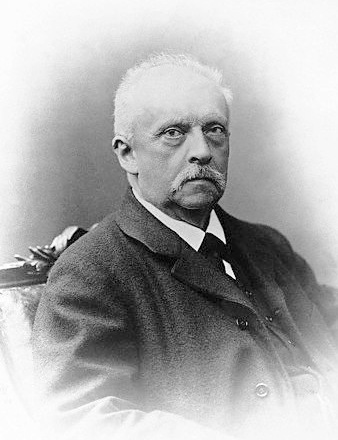
As a young man, Helmholtz was interested in natural science, but his father wanted him to study medicine at the Charité because there was financial support for medical students.
Trained primarily in physiology, Helmholtz wrote on many other topics, ranging from theoretical physics, to the age of the Earth, to the origin of the Solar System.
In physiology and psychology, he is known for his mathematics of the eye, theories of vision, ideas on the visual perception of space, color vision research, and on the sensation of tone, perception of sound, and empiricism in the physiology of perception.
In physics, he is known for his theories on the conservation of energy, work in electrodynamics, chemical thermodynamics, and on a mechanical foundation of thermodynamics.
In physics, he is known for his theories on the conservation of energy, work in electrodynamics, chemical thermodynamics, and on a mechanical foundation of thermodynamics.
As a philosopher, he is known for his philosophy of science, ideas on the relation between the laws of perception and the laws of nature, the science of aesthetics, and ideas on the civilising power of science.
Students and research associates of Helmholtz included Max Planck, Heinrich Kayser, Eugen Goldstein, Wilhelm Wien, Arthur König, Henry Augustus Rowland, Albert A. Michelson, Wilhelm Wundt, Fernando Sanford and Michael I. Pupin.
Helmholtz is known for -
- Studies in the conservation of energy
- Helmholtz condition
- Helmholtz decomposition
- Helmholtz equation
- Helmholtz free energy
- Helmholtz free entropy
- Helmholtz layer
- Helmholtz pitch notation
- Helmholtz reciprocity
- Helmholtz resonance
- Helmholtz temperament
- Helmholtz classical theorem
- Helmholtz's theorems
- Helmholtz minimum dissipation theorem
- Generalized Helmholtz theorem
- Gibbs–Helmholtz equation
- Helmholtz-Ellis notation
- Helmholtz–Kohlrausch effect
- Helmholtz-Smoluchowski eqn.
- Kelvin–Helmholtz instability
- Kelvin–Helmholtz mechanism
- Young–Helmholtz theory
- Additive synthesis
- Efference copy
- Hydrodynamic stability
- Keratometer
- Pure tone
- Supercapacitor
How did he get so much time!?

