A new study shows that Earth’s moon should, theoretically, be able to have its own moon. Why doesn’t it?
 |
| Size comparison of the major moons in our solar system |
Most of the planets in our solar system have orbiting moons, and even some asteroids have their own moons. But do any moons have moons? Is it possible? Could there be so-called submoons?
It’s a simple enough question. If most other objects in the solar system can have moons, why not moons themselves? Researchers decided to try to answer this question of a 4 year old. Their results have now been published in a new peer-reviewed paper in the February 2019 issue of the Monthly Notices of the Royal Astronomical Society.
Planets orbit stars and moons orbit planets, so it is natural to ask if smaller moons could orbit larger ones. So far at least, no submoons have been found orbiting any of the moons considered most likely to support them – Jupiter’s moon Callisto, Saturn’s moons Titan and Iapetus and Earth’s own moon.
The lack of known submoons in our solar system, even orbiting around moons that could theoretically support such objects, can offer us clues about how our own and neighboring planets formed, about which there are still many outstanding questions.
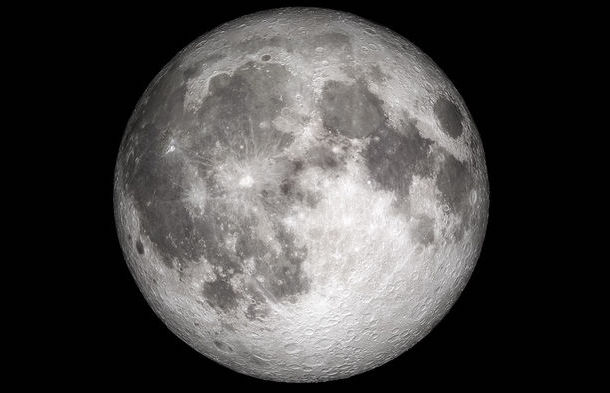 |
| Earth’s moon should theoretically be able to have its own moon. Why doesn’t it? |
Researchers found that only large moons on wide orbits from their host planets would be capable of hosting submoons. Usually, any submoons orbiting smaller moons closer to their planet would have their orbits destabilized by tidal forces. Jupiter’s large moon Callisto, Saturn’s large moon Titan, another Saturn moon called Iapetus and Earth’s moon could all theoretically have submoons, so why don’t they?
There may be other sources of submoon instability, such as the non-uniform concentration of mass in Earth’s moon’s crust.
Part of the answer might also have to do with how the primary moons formed in the first place. Earth’s moon is thought to have been born out of a collision between Earth and another body about the size of Mars – and that collision may have helped life on Earth to get started. But some other moons, like those orbiting Jupiter and Saturn, originated from the same cloud of gas and dust that the planets themselves formed from.
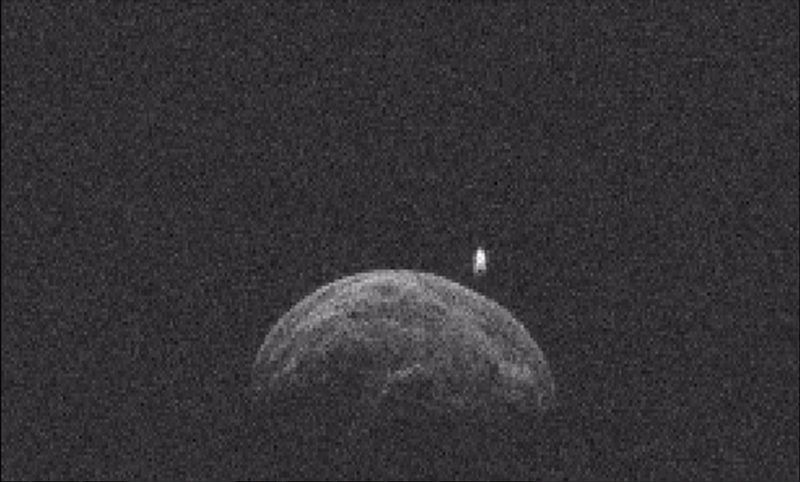 |
| Even asteroids can have moons, such as 2004 BL86. It is about 325 meters in diameter, and its moon is tiny, only 70 meters wide. |
It may be that in many or even most cases, there are multiple factors that make the orbits of submoons inherently unstable. Knowing whether that is true or not may have to wait for discoveries of moons orbiting distant exoplanets. Moons themselves are much harder to detect and only one promising candidate has been found so far – a possible exomoon orbiting the Jupiter-sized exoplanet Kepler-1625b. That possible moon – about the size of Neptune – is large enough and far enough from its planet that submoons should be possible as well. Astronomers will need to verify that primary moon first – if it does exist – before looking for any submoons.
Even though Earth’s moon doesn’t have a submoon now, it may in the future, according to the researchers – an artificial one, perhaps NASA’s planned Lunar Gateway. The Lunar Gateway would help to establish humanity’s presence in deep space.
The possibility of moons having their own moons is a fascinating one, even though we haven’t found any examples yet. This new research from Carnegie Science shows that it is indeed possible, but only under the right circumstances.

